Category: Uncategorized

  • Revolver vs. Semi-Auto Pistol

    A common question in many classes is whether there are benefits to a revolver vs. a semi-automatic pistol for every day carry (EDC). It is a great question, and does require some thought, so I will try to hit the high points here.

    Disclaimer: My EDC is a semi-automatic pistol. I am a bit biased towards them, but I am going to do my best to be unbiased in this short article.

    Ease of Use

    Revolver

    • Firing – Once it is loaded, you simply pull the trigger. OK, that may seem overly simplistic, but it really kind of sums it up. The main drawback of a revolver is that the trigger is usually longer and requires more force. Other than the trigger being a bit tougher, a revolver is incredibly easy to shoot as there is nothing to it other than pulling the trigger until you exhaust the bullets in the cylinder.
    • Reloading – The process of reloading a revolver requires speed loaders (if you want to be able to dump everything in the cylinder and load fresh rounds), speed strips (if you want to manually remove each spend round and then quickly put in one or two at a time), or manually removing one round at a time and replacing it. In other words, being able to do a tactical reload is a bit compromised.
    • Malfunctions – For a Type 1 malfunction, you simply pull the trigger again and the revolver advances to the next round and tries to fire it. There is no such thing as a Type 2 or Type 3 malfunction for a revolver.

    Note: There is also no such thing as limp wristing (not holding the fun tightly and letting it recoil and flip in your hand) a revolver and it causing a malfunction like you can have with a semi-automatic pistol.

    Semi-Automatic – The semi-automatic is a good bit more difficult to operate. Yes, once it is loaded, you can also just pull the trigger and keep pulling the trigger until the slide locks back on an empty magazine.

    • Firing – Once it is loaded, you simply pull the trigger. However, loading does require more effort than a revolver in that the owner must rack the slide and verify that the first round is in the chamber. Generally, semi-automatics have much lighter trigger pulls than revolvers. I say that as a generalization as there are exceptions to most every rule.
    • Reloading – The process of reloading a pistol is much simpler than a revolver as the owner only needs to drop the magazine and insert another magazine. This process takes less than a second for an experience user. If the slide locked on an empty magazine, then the slide will need to be moved forward (dropped) to load the first round of the new magazine. 
    • Malfunctions – This is where it is much more complex to run a semi-automatic pistol than a revolver. Type 1, Type 2, and Type 3 malfunctions take multiple steps to clear them, and require some training as it is far from intuitive. 

    Safeties

    Revolver – There are none. Revolver manufacturers will say that the long and hard trigger pull is considered a safety, and many people will agree. Pulling the trigger takes effort and thought, and is, generally, not accidental.

    Semi-Automatic – The safeties on a semi-automatic can be many. There are drop safeties to protect against the gun going off if it is dropped on the ground or jolted. There are trigger safeties that require the trigger to be properly manipulated before firing, and there are also other manual safeties that must be disengaged before firing.

    Capacity

    Revolver – Most revolvers hold either five or six rounds depending on the size of the revolver and the caliber of the rounds.

    Semi-Automatic – Semi-automatics vary in capacity from six rounds (the lowest that I could find in my quick search) to 17 in the Glock and even 20 in the FN Five-seveN. There are extended magazines available for many semi-automatics as well, so it is possible to have much more.

    Summary

    Revolvers and semi-automatic firearms are both very valuable self-defense weapons. They both have pros and cons, and it is us to us to choose what best fits our needs.

    I strongly suggest that each person looking at buying a firearm take the time to attend training and try multiple firearms before making a purchase.
  • I Want a Conceal Carry Firearm–What Should I Get?

    Short answer: The one that is best for you.

    Long answer: It depends on many factors.

    Size – Size matters. I don’t care how many times you have heard that size doesn’t matter. It matters! I think it is fair to say that we make decisions about size all of the time. For example, we choose our cars based on our needs, which includes the size. We choose our homes based on the size of the rooms and overall size of the house. It is the same with our guns.

    Larger guns are, generally, easier to shoot. The additional weight help reduce recoil , the additional length of the site radius, and the larger grip surface make a big difference. Larger hand guns are often referred to as duty guns, service guns, and full size guns.

    Smaller hand guns, especially pocket sized guns, are much harder to shoot for the exact opposite reasons, above.

    Capacity is another concern when it comes to size. A larger gun will carry more rounds.

    Conceal Carry Firearms have a different purpose than a range gun, for example, and sacrifices must be made when it comes to size.

    Comfort – Size is part of the comfort factor. Obviously, a larger gun will be less comfortable to carry. A gun that is not comfortable to carry will not be carried, and we are back to shopping for a new gun.

    Method of carry is an important consideration. Will the gun be carried inside the waistband, outside the waistband, appendix, shoulder, ankle, pocket, or off-body?

    Weight is part of the size equation. A heavier, all steel gun, for example, will require a stiffer belt, and will also impact comfort more and more over time as additional weight always is a concern.

    Speed to draw is another consideration when it comes to comfort. Depending on how you carry the gun and and the size, it may not lend itself to a quick draw.

    Concealability –Size is one of the impacts here, as well. Smaller guns are easier to conceal. That is just common sense.

    Holsters will impact concealability. Some holster provide for deeper concealment than others. The material of the holster will impact how well it molds itself to the body. However, it really does come down to the gun itself and what holsters are available for the chosen gun.

    Lifestyle and weather are very another important concern. What do you wear? For example, in cold climates, it is much easier to conceal a larger gun, but it can be a huge challenge if you wear running shorts and tight t-shirts and still need to conceal a gun while out on a long run. Let’s not forget those that wear tailored suits have their own unique challenges. How about those that drive for a living and the choices for those individuals.

    Performance – Can you shoot the gun well, and shoot it well under pressure? This is the most important question. If you can’t shoot it, why would you carry it and depend on your ability to shoot it under huge amounts of stress?

    Feel – Is it comfortable in your hand?

    Sights – Can you see the sights and get a good sight picture, quickly? Luckily, sights are easy to replace with ones that you can use to acquire your target quicker than the stock sights.

    Trigger – Is the pull smooth and easy enough so that it won’t cause you to miss? We see stories all the time about police missing their targets and hitting innocent bystanders. We don’t want to use a horrible trigger that will make it harder to hit our target.

    Recoil – As many people will learn, it isn’t about that one shot. In many cases, you will need to shoot multiple times to stop the attack. Strong recoil makes it difficult to get back on target with follow-up shots.

    Cost – Most of us don’t have extra money laying around. I am sure you have heard that “you get what you pay for” several times. This is, somewhat, true when it comes to a gun. Remember, you are depending on this tool and it has to work when you need it. The balance between cost and performance can be challenging. I, personally, have seen some great, inexpensive guns that are fantastic options. I have also seen some guns that cost more than my car, but that doesn’t really make them better for conceal carry.

    Training – This should actually be part of the cost. It doesn’t matter if you have the perfect gun if you do not know how to use it well. Good training, and lots of practice are vital when it comes to conceal carry. Improving the software (the shooter) is often a much better investment that getting better hardware (the gun).

  • My Gun Does Not Shoot Where I Aim

    NOTE: This post is focused on hand guns.

    This is one of the most common posts on gun groups. Somebody will pop in, pretty much every day, saying something like, “I got a new gun, and it seems to shoot left/right/high/low/upside down. What is wrong?”

    It is a pretty good question, it is too bad that the answers seem to suck. The answers are always:

    • Aim the other direction so your shots hit the target. This one wins the award from me for being the most ignorant response.
    • Fix your grip on the gun.
    • Fix your finger position on the trigger.
    • Adjust your stance by blading more the other direction.
    • Change your ammo, some guns only like certain ammo.
    • Take it to a gun smith and have them fix it.
    • Return it to where you bought it and have them sell you one that works.

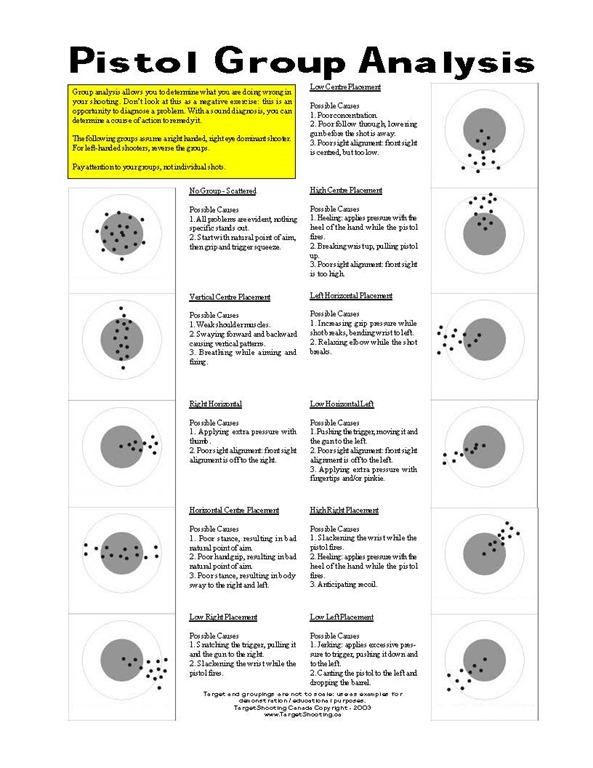
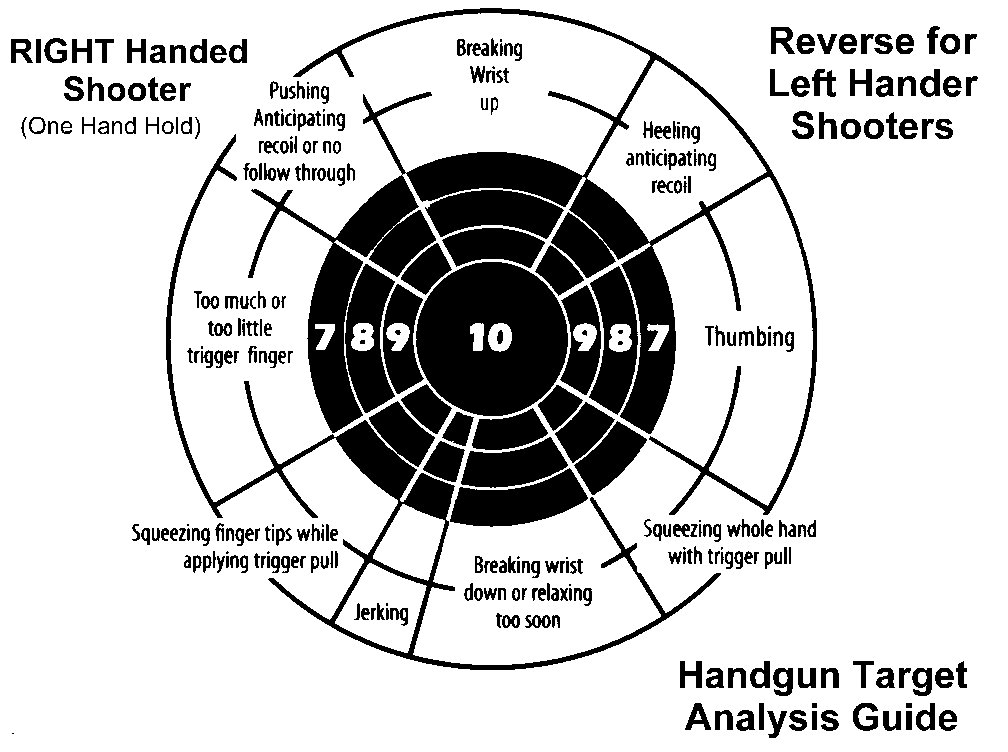
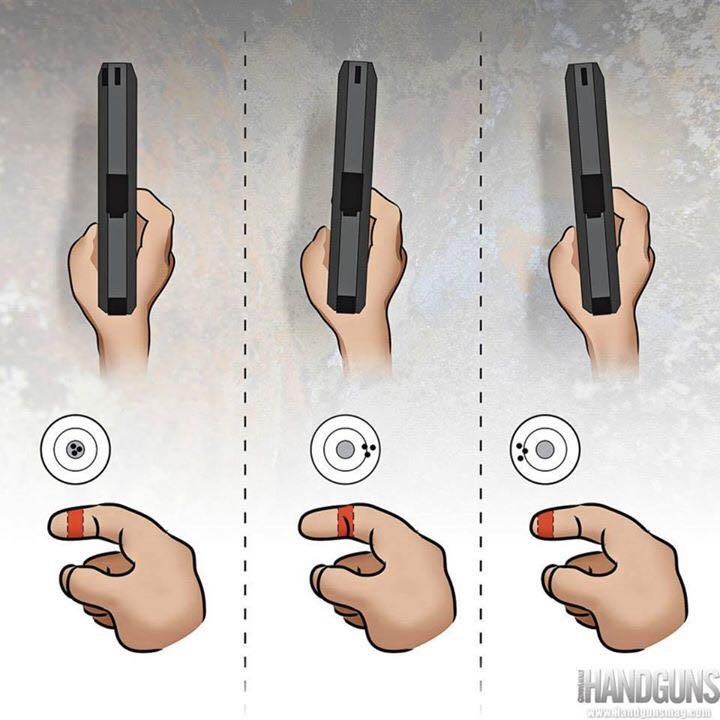
    I want to cry for the community. We have way too many people that just don’t know enough, yet. Hopefully, they will eventually learn. Those that have been around will also post one of these pictures shown.Target Analysis

    To be fair, often, these are helpful. However, the first step should be to identify if it is the shooter or the gun. After all, it might be the sights are off. Of course, it is most likely the shooter, but we need to make sure before we start telling them what they are doing wrong.

    How do you test whether it is the gun or not? Well, there are a couple of ways. trigger finger

    • Put the gun in a ransom rest. If the shots are off left or right, then it is probably the rear sight needs to be adjusted. While it could be the front sight, many guns do not offer an adjustment for the front sight. Those that do offer the ability to adjust the rear sight, it will often require drifting the sight, and you probably should engage a gun smith to help out unless are experienced.
    • Have an experienced shooter test it while in a well supported shooting position using a rest for the front and rear of the gun to minimize any movement.

    Moving Your Sights

    Grip AnalysisAssuming that you are certain that the gun’s sights need to be adjusted, then remember the FORS rule. This stands for Front Opposite Rear Same. For example, if you want to move the point of impact to the right, then you would move the rear sight to the right (the same direction).

    As far as up and down, that is something that requires extra consideration. First off, very few hand guns have vertical adjustments. However, whether the sights can be adjusted up or down or not is secondary to selecting what distance the gun should be zeroed. For example, some guns are zeroed at closer distances and other are zeroed at longer distances. Truthfully, it doesn’t really matter as handguns will not see much trajectory drop as they are shot at very close ranges and there is little variance between 5 yards and 25 yards for most handgun rounds. A typical 9mm round, for example, will only drop about half an inch over 25 yards.

    Summary: Identify whether the problem is with the gun or the shooter, then resolve the problem.