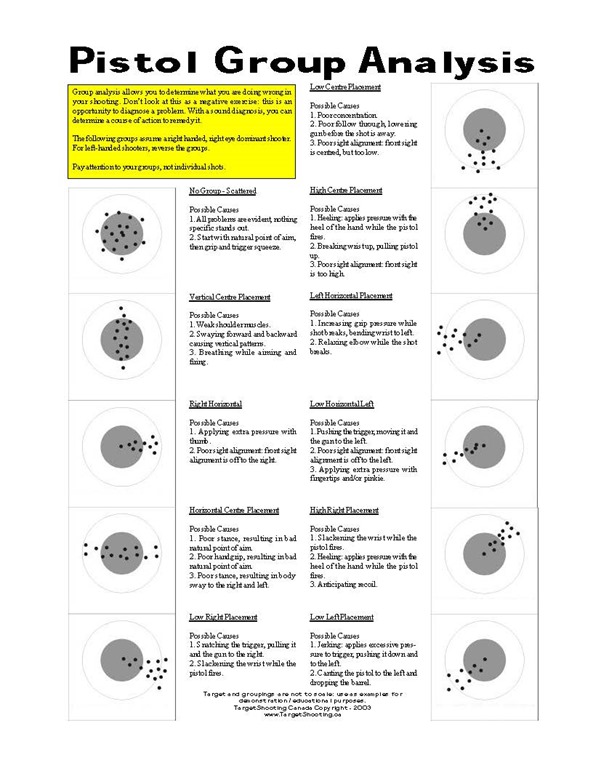
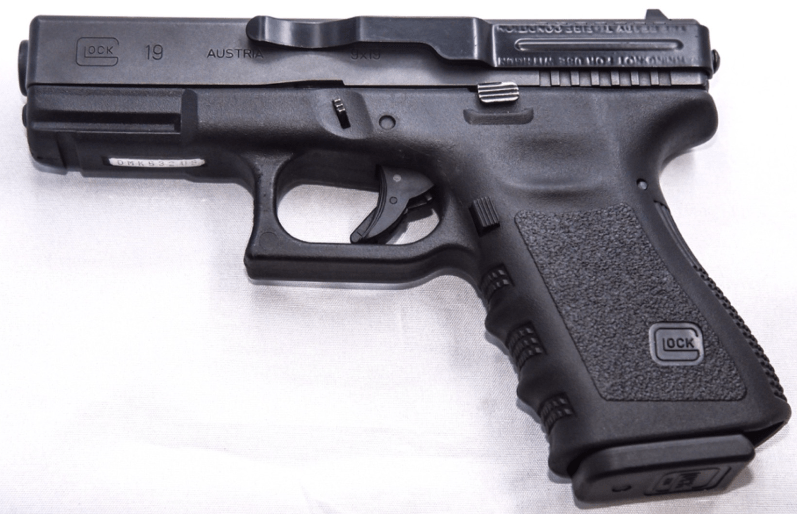
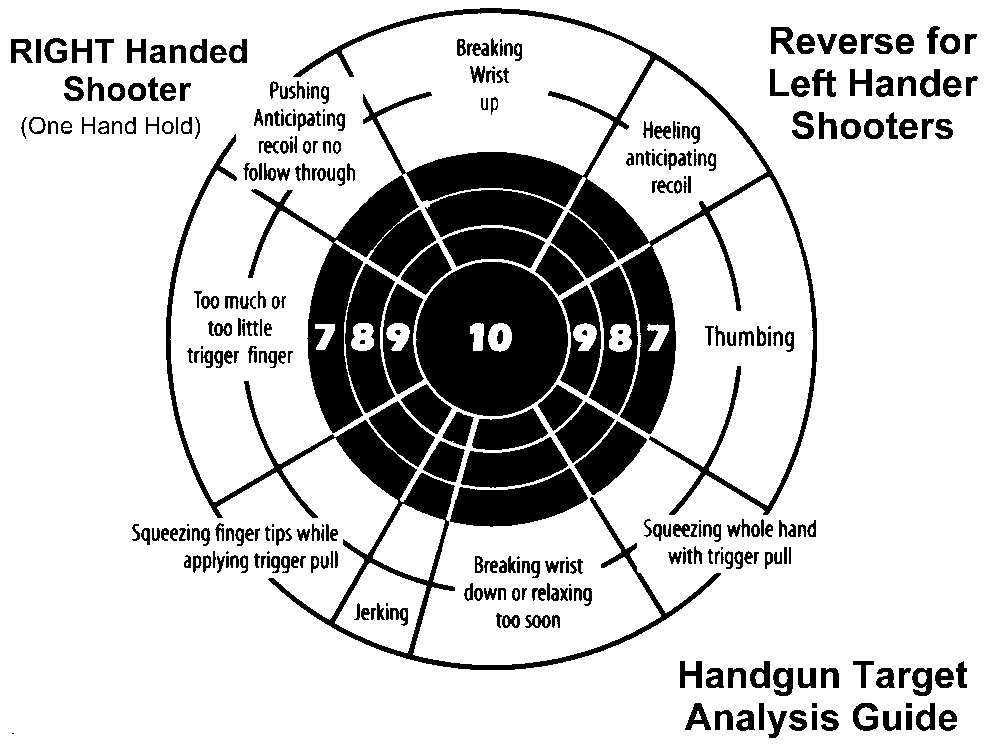
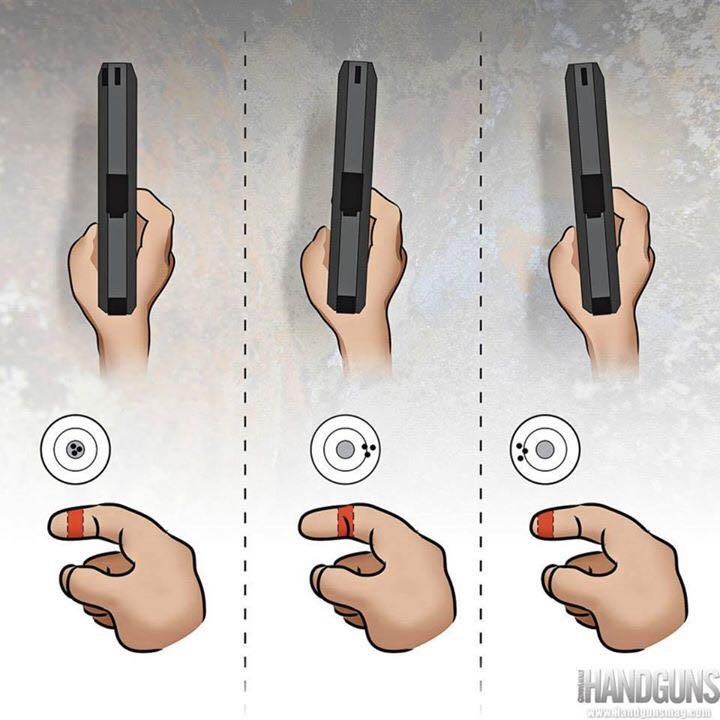
Author: Russ Kaufmann

  • Nobody Wants to Take Your Guns

    I still hear it on a regular basis. Gun control activists like to say that nobody wants to take your guns when having discussions with Gun rights activists.

    Clearly, they are being disingenuous. Either that, or they are just incredibly ignorant about what the gun control political leaders want to accomplish. I am going with the former.

    It is clear that confiscation is the real desire, but at least several of them understand that they will need to get there, gradually.

    Here are several examples, and there are several more out there, but I just got tired of putting these together. I have better things to do with my time than prove gun grabbers to be stretching the truth, which would be the nice way of calling them outright liars.

    I won’t bother commenting on each one. They are all very clear.

    Biden, Joseph – US Senate, US Vice President

    “Banning guns is an idea whose time has come.”

    Bloomberg, Michael – NYC Mayor, Presidential Candidate

    “It’s the job of law enforcement to have guns and to decide when to shoot. You just do not want the average citizen carrying a gun in a crowded place.”

    Clay, William – US Representative

    “The Brady Bill is the minimum step Congress should take…we need much stricter gun control, and eventually should bar the ownership of handguns, except in a few cases.”

    Clinton, Bill – US President

    “I feel very strongly about it [the Brady Bill]. I think – I also associate myself with the other remarks of the Attorney General. I think it’s the beginning. It’s not the end of the process by any means.”

    Clinton, Hillary – US Secretary of State, Presidential Candidate

    “I don’t know enough details to tell you how we would do it or how it would work, but certainly the Australia example is worth looking at.”

    Cuomo, Andrew – NY Governor

    “Confiscation could be an option. Mandatory sale to the state could be an option.”

    Davis, Danny – US US Representative

    “I am saying I would like to make it where nobody except military personnel would ever have access to these weapons.”

    Fass, Barbara – Stockton, CA Mayor
    “I think you have to do it a step at a time and I think that is what the NRA is most concerned about. Is that it will happen one very small step at a time so that by the time.”

    Feinstein, Diane – US Senate

    “Banning guns addresses a fundamental right of all Americans to feel safe.”

    “If I could have gotten 51 votes in the Senate of the United States for an outright ban, picking up every one of them… ‘Mr. and Mrs. America, turn ’em all in, I would have done it. I could not do that. The votes weren’t here.”

    Frosh, Brian – Maryland Attorney General

    “We should ban guns altogether, period.”

    Himes, Jim – US Representative

    “Nobody wants to take away people’s guns. We just don’t want to be any different than Canada, or Australia, or Great Britain.”

    Jackson-Lee, Sheila – US Representative

    “I would personally just say to those who are listening, maybe you want to turn in your guns.”

    Metzenbaum, Howard- US Senate

    “I don’t care about crime, I just want to get the guns.”

    Morse, John – Colorado Representative

    “People who own guns are essentially a sickness in our souls who must be cleansed.”

    Muhlbauer, Dan – Iowa Representative

    “The state of Iowa should take semi-automatic weapons away from Iowans who have legally purchased them prior to any ban that is enacted if they don’t give their weapons up in a buy-back program.  Even if you have them, I think we need to start taking them.”

    Obama, Barrack – US President

    “We know that other countries, in response to one mass shooting, have been able to craft laws that almost eliminate mass shootings. Friends of ours, allies of ours — Great Britain, Australia, countries like ours. So we know there are ways to prevent it.”

    O’Rourke, Robert Francis “Beto” – US Representative

    “’Hell, yes, we’re going to take your AR-15, your AK-47.”

    Owens, Major – US Representative

    “My bill … establishes a 6-month grace period for the turning in of all handguns.”

    Reno, Janet – US Attorney General

    “Waiting periods are only a step. Registration is only a step. The prohibition of private firearms is the goal.”

    Schakowsky, Jan – Illinois Representative

    “We want everything on the table. This is a moment of opportunity. There’s no question about it…We’re on a roll now, and I think we’ve got to take the–you know, we’re gonna push as hard as we can and as far as we can.”

    Schumer, Charles – US Representative

    “We’re here to tell the NRA their nightmare is true.”

    Waxman, Henry – US Representative

    “If someone is so fearful that they are going to start using their weapons to protect their rights, it makes me very nervous that these people have weapons at all.”
  • Transitional Spaces

    Definition

    First, the definition: Transitional spaces are spaces where we pass from one place to another, and are usually “uncontrolled.”spaces we must pass through when going from one place to another.

    Examples: This list is not exhaustive, but it should provide insight into the concept.

    • Going from your house to your car and from your car back to your house.
    • Exiting your car to go into the store and, especially, going from the store to your car.
    • Going from one store to another across a courtyard.
    • Crossing the street to the neighbors house.
    • Driving through an area.

    “Danger zones” is another way to think of these spaces.

    Why Do We Care?

    “Danger zones” is why we care.

    Criminals tend to stakeimage out these transitional spaces and watch for potential victims. Lots of people make themselves out to be vulnerable because they aren’t taking due care in these transitional spaces.

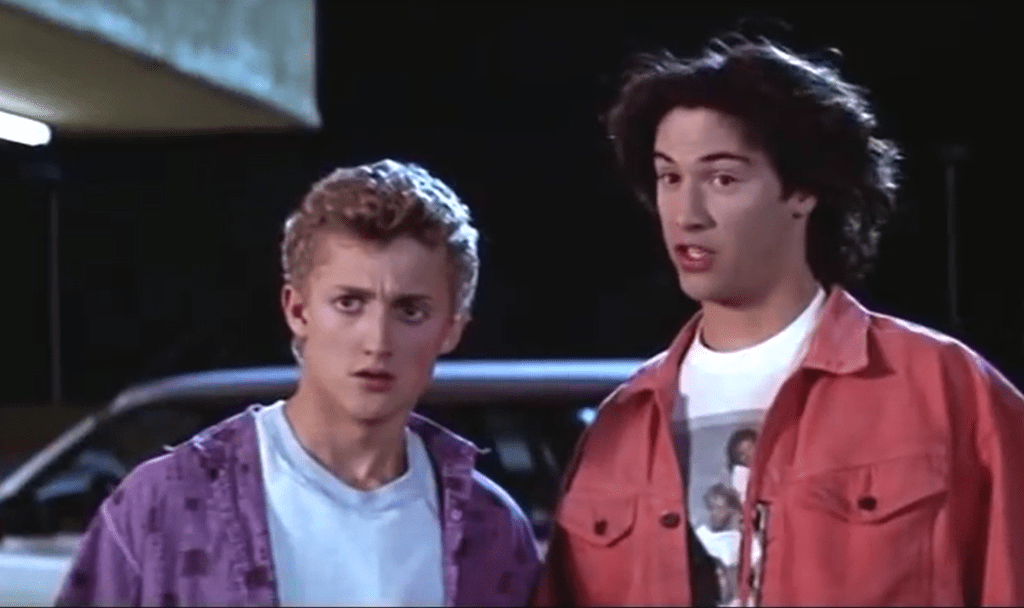
    In the words of Bill and Ted, “Strange things are afoot at the Circle K.” What happens in the parking lot of the Circle K can be very “iffy” and should concern all of us.

    What Should We Do?

    It is pretty simple, don’t look like a vulnerable victim.

    • Understand the area. Know the boundaries. Know where criminals might be at, how they might approach.
    • Don’t be alone. A lone victim is a much better target than a couple or a group.
    • Be aware. Too many people have tunnel vision when passing through a transitional space. Don’t look at your phone and check for text messages, or make a call.
    • Hands free. While it is likely that you might be carrying a bag when leaving a store, try to keep a hand free. You might need it. At a minimum, be prepared to drop your bag so you will have free hands to defend yourself.
    • Plan your transition. Understand your path, understand where you will be most vulnerable and try to avoid those vulnerable moments, if possible.
    • Be prepared. This may sound like a stupid statement, but so few people are prepared to defend themselves and they don’t have a contingency plan for when things go wrong and don’t work out like they planned.
    • BE AN ASSHOLE. Yes, be prepared to be an asshole. It has happened to me multiple times, where I have had criminals try to “interview” me and gauge whether I am a potential victim. You may see it happen in parking lots every single day where somebody tries to get close to you with a “Hey, got a minute? I need some help” statement or something similar. Be an asshole, and tell them, loudly and clearly, “Stop right there and keep your distance” so that they know that you are not a potential victim.

    Summary

    Be vigilant. Be safe. Be an asshole.

  • Mental Preparation

    I was talking to a couple of friends and a couple of guys I had just met, recently. Each of us are involved in teaching defensive imageshooting and defensive tactics. One guy is somebody that I served with in the Army many oh so many moons ago, one is a 20+ year police veteran that worked in Detroit, and the other two are, in their own words, “just a couple of guys that train because we want to protect ourselves and our families.”

    After a few minutes of BS, and some discussions about our different backgrounds, we found a couple of topics that really stuck with us and drove the rest of the discussion:

    • Tactics differ between the military, police, and civilian worlds. They are dramatically different.
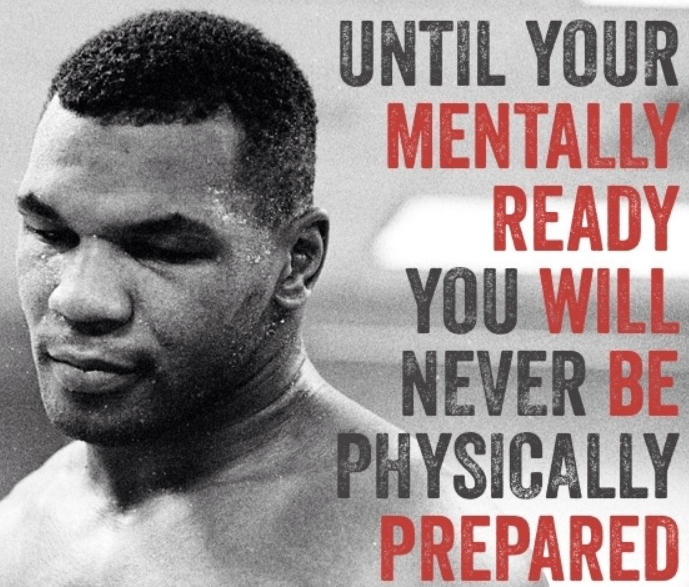
    • The mental aspect needs to be a major focus in training.

    Let’s focus on the latter for a this post. I have a couple of great examples.

    Example 1

    My police friend told us a story about being called out to a shooting. He got there, and found the victim, alive, but in serious jeopardy of dying. As he applied first aid and was waiting for medical services, he heard the victim tell the story.

    The victim was approached about a block from the ATM machine by a guy asking if he had a lighter or match as his lighter was out. As he started to say that he didn’t smoke, the other guy got closer and then within a couple of feet, then demanded the money he just got out of the ATM. The victim finally clued in, way too late, and tried to get distance and pull out his gun and yell at him to get away. The guy then punched him, and took his gun away from him. The victim then tried to rush him, and got shot. While they were talking, he asked the victim why he didn’t shoot. The victim told him that he would never shoot somebody and that he only carried the gun to scare away potential attackers.

    My police friend said that he had the victim’s conceal permit taken away while the victim recovered in the hospital. He told the Sheriff that issued it that he said he would never shoot somebody, so there was no reason to let him carry a gun. I am sure several of you reading this are thinking, “I would have shot him.” I will have to say, yeah, I bet you believe you would have, but, really would you have shot him? After all, he wasn’t armed.

    Example 2

    My military friend said, “I am not shocked to hear that he didn’t shoot. I am shocked to hear that he had made the decision long ago that he would never shoot anyone.” Then he looked at me and said, “No, I will tell this one. Don’t you dare say anything.” He then proceeded to tell his story.

    During a mission, him and the other three members in his team were trying to get close to an enemy position so they could call in indirect fire. As they maneuvered through some dense jungle, being as quiet as possible as the team was not to engage the enemy, they were there to find the target, verify it, and call for fire. He was on point, at the time, and coming around a couple of trees, he came face to face with two guys on perimeter security for our target. He froze. The three of them all froze just looking at each other. He said it felt like they looked at each other for several minutes, then he heard the shots that killed them.

    One of the team, shot them. A burst into each of them.

    They were blown, and they had to haul ass and get out of the area.

    I am sure some of you are thinking, yeah, he trained for that, and failed. That is on him, and he must have had some crap training. This is somebody that I respected more than the vast number of people that I served with in the past. He was somebody that I always trusted to have my back. He, later, proved himself over and over.

    Mental Prep

    As we talked, it was clear that some people just don’t do what needs to be done for whatever reason. It can be conscious choice or just being startled and the training not kicking in like expected. It happens.

    The question is how you train to be able to do what needs to be done at that critical moment. We all kind of agreed that force on force training doesn’t help because everyone knows it isn’t real. It may was well be paint ball.

    We all, kind of, agreed that it is all about the mental reps. You have to imagine the scenarios, you have to visual drawing and shooting. You have to imagine the after action and what you will do when the threat is done. You have to imagine it all over and over and over again. You have to visualize it until it becomes real and so that, just like drawing and aiming, it becomes muscle memory. It needs to become an automatic response to the triggers that you imagine and that fit with when you are willing to shoot to defend yourself and your loved ones.

    I am sure there is more to it, but that is what we all got out of the conversation.

  • Type 3 Malfunction

    What is it?

    This malfunction is often described as a double feed. Basically, there is a mess of stuff going on in the gun. One round failed to extract, and another round was picked up by the slide and it tried to feed into the occupied chamber.

    Symptom: The trigger feels squishy or just wrong to the shooter. In most of these imagemalfunctions, the slide has not gone cycled far back enough to reset the trigger. This malfunction can be caused by:

    • Bad extractor
    • Dirty gun or not properly lubed gun
    • Magazine failure

    Issue: This malfunction is unique because it involves the following multiple forces fighting each other:

    • Magazine spring – The magazine spring pushes up on the rounds to hold them up in place. The top round is being pushed up against the top of the slide.
    • Recoil spring – The recoil spring forces the new round forward using all its strength.
    • Magazine lip – The magazine lip, is also involved as it is locking the new round in the imagemagazine. While this isn’t true for all magazines, most magazines will still hold the round in the top of the magazine as it has not had a chance to be moved completely free of the magazine. The magazine is a major issue here as it can’t just be dropped, and it can’t even be ripped out in many cases.

    So what do you do?

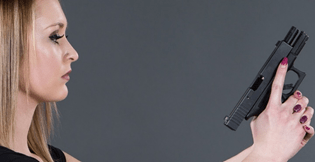
    1. Move! – You just experienced a malfunction, and you need to get out of the line of fire, imagepreferably to some cover. While moving, you need more information, so you should be tiling up your gun so you can see if you can identify the problem.
    2. Lock – Lock back the slide. For most semi-automatics, we have to lock the slide back to relieve the pressure of the recoil spring. In this step, we make sure that the magazine is fully seated.
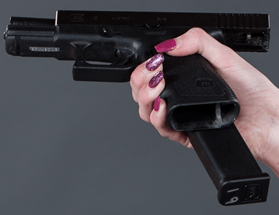
    3. Rip – Once the recoil spring pressure has been relieved, you can press the magazine release and rip out the magazine. It will, probably, not drop free by itself. You will need to use some physical force.
    4. Retain- Retaining the magazine saves critical time and the critical rounds that it holds. It is imagepretty simple to slide the magazine between the gun’s stock and your hand. Since so many people only carry the magazine in their gun, they don’t have the option of dropping the magazine. Of course, if the magazine is defective, it will still be a problem, which is the main reason to have another magazine available.
    5. Rack, Rack, Rack – Rack the slide, vigorously. You need to rack it multiple times to make imagesure that the round in the chamber is cleared. Keep the magazine in place as you rack the slide.
    6. Insert – Insert the magazine back into the gun. Better yet, replace the magazine with another one as the failure might be magazine related, and you will have the same issue.
    7. Rack – You need to rack the gun again, to feed a round into the chamber.
    8. Sight In – You  need to get that sight picture and resume shooting if the threat still exists.

    All steps should be performed at eye level so that you can continue to assess the target. The target may no longer be present or may have stopped because of previous hits.


  • Thousand Oaks Shooting

    Since the 72 hour time frame has passed, by a good bit, and we now have a great deal more information than right after the shooting, I decided it is time to post this and provide some of this information and some of my thoughts.

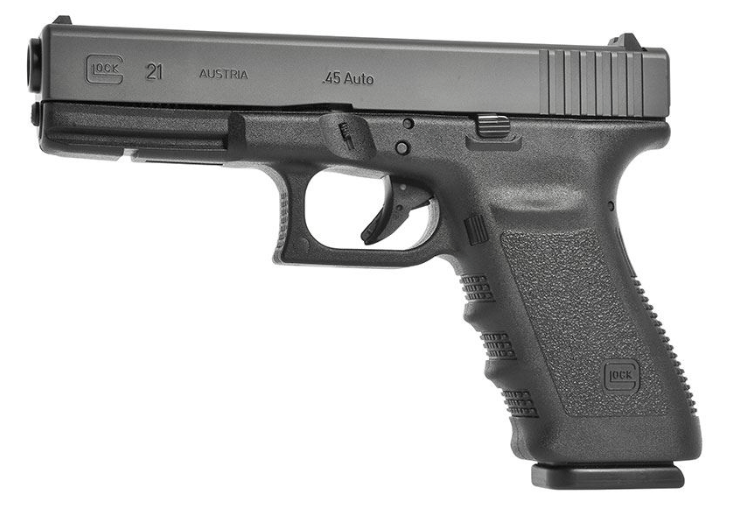
    Firearm: Glock 21, .45 Caliber, imagestandard magazine holds 13 rounds. CA compliant magazine holds 10 rounds. It has been stated that an “extended” magazine was used, but it is not clear whether that means a 13 round standard capacity magazine or some other capacity was used.

    Shooter: Former Marine. It is unclear whether he still suffered from PTSD or not, even though he had treatment in the past. He was not a known Jihadist or anything like that.

    Summary of Action: The shooter shot the outside security guard, then entered and fired on the crowd using at least two magazines.

    California Laws

    Just a quick summary of some of the laws of California, where legislators believe that gun control laws work, and continue to push for more and more laws.

    Firearm Safety Certificate – All purchasers are required to pass a written test that is proctored by a DOJ approved instructor before purchasing or receiving a handgun. This law did not prevent the shooting.

    Universal Background Checks – California has implemented universal background checks that cover all transfers, including loans, of firearms. All sales and transfers are recorded by the state of California. The Glock 21 was legally acquired. The law did not prevent the shooting.


    Handgun Roster
    – Only certain guns, meeting requirements as specified by the state, are allowed. All manufacturers have to pay for the testing to be allowed on the roster. Also, it might be noted that this law is being challenged as a de factor ban as any new firearms are required to meet standards that can’t be met with today’s technology. The Glock 21 is on the roster. The law did not prevent the shooting.


    10 Day Waiting Period
    – California requires a 10 day waiting period for the purchase of firearms. Supposedly, this cooling off period will prevent killings, even though there is no proof of this being a deterrent or helping to reduce violence. The law did not prevent the shooting.

    New Resident Report of Firearm Ownership – All people moving to California, that have firearms, are required to file a report within 60 days of moving to California. This law did not apply. However, the law did not prevent the shooting.


    Ammunition Purchases
    – A new laws allows ammunition to only be purchased from  federally licensed dealers. All ammunition was legally purchased. The law did not prevent the shooting.


    Red Flag Law
    – California is one of the first states to implement a red flag law that allows friends and family to apply to the court to have a person’s firearms taken away from them without due process. However, in the case of this person, he was evaluated by a mental health specialist who cleared him of needing to be committed to a mental facility for treatment. There are no known applications that were submitted to the court, in this case. The law did not prevent the shooting.

    CCW Permits – It is well known that California severely restricts conceal carry weapon permits. California is a “May-Issue” state and has no reciprocity with other states. Very few counties will issue permits to the standard citizen, despite training. Political or celebrity influence is a requirement to get a permit in most counties. This law did not prevent the shooting. However, the law prevented a trained and capable private citizen from being armed and able to stop the threat.

    Magazine Capacity Limit – Laws exist to prevent the purchase or import of magazines that hold more than 10 rounds. A newer law, Proposition 63, was put in place to apply this same limit to all previously grandfathered magazines. Proposition 63 currently is suspended pending further legal action. Despite claims that an “extended” magazine was used, this has not been made clear. To help understand this, please note the the standard magazine that comes with the Glock 21 when purchased in other states, holds 13 rounds. It is possible that 13 round magazines were used. It is possible that 10 round magazines were used. In either case, it is clear that the shooter changed the magazine. The answer as to what capacity magazine was used is not answered, yet. Even if an “extended” magazine were used, it would not have been a significant factor as it has been shown that changing a magazine takes less than second for a trained person. The law did not prevent the shooting.

    “Assault Weapon” Ban – This is another of the many laws put in place that did not impact this incident. I can go on and on about the many issues with this law, but that is for another day. The law did not prevent the shooting.

    Other Notes

    Police Off-Duty Policy – This is not a law, but it is important to note that all six off-duty law enforcement officers at the shooting were unarmed. I have heard that it is a policy that prevents them from carrying when off duty, but i have not confirmed this. Not a law, but it appears to have prevented a trained and capable law enforcement officer from stopping the threat.

    Time – The reports say that the initial shooting took about 2.5 minutes. I hope to see a better timeline, soon.

    Firearm – The Glock 21 used is not a firearm that would be banned or subject to any special legislation. It is a widely available handgun that is often used for home defense. This was not an evil looking “Assault Weapon.”

    Summary

    Shootings like this can happen anywhere, even in towns considered to be extremely safe. The inability for potential victims to respond leads to more victims. In this case, there were several unarmed law enforcement officers at the incident.

    I feel that it is horrible that the state of California has disarmed its citizens and made them more susceptible to these kind of shootings. It is even worse if the officers were unarmed because of some short-sighted policy.

  • Parking Lot Shooting in Florida

    The Short Version of the Story

    In case you had not seen this when it hit the news, a man was attacked, then shot and killed his attacker. Well, there is more to it, so here is the summary.

    It all started when Britany Jacobs was parked in a handicap spot, without the proper plate or permit. Michael Drejka,47, approached her and started yelling at her and berating her for the violation. Jacob’s boyfriend of many years, Markeis McGlockton, 28, was in the store and heard the commotion. McGlockton came out of the store and attacked Drejka. McGlockton threw Drejka to the ground. Drejka drew his gun and shot and killed McGlockton.

    The Long Version of the Story

    It doesn’t really matter that Drejka has a history of provoking trouble or that he had been charged with felonies in the past. Supposedly, Drejka had started a fight with another person, in the past, for parking in the same handicap parking spot.

    The long version of the story doesn’t really matter, at all. So, we will not discuss it, in any sort of depth, here.

    The Video

    In the video, Drejka approaches the car in the handicap spot at about 1:18 andimage you can see him looking at the front of the car, possibly checking the plates. He proceeds to point at Jacobs and talk to her, possibly yelling at her. At about 2:43, McGlockton comes out of the store and strides towards Drejka then shoves him to the ground, hard at about 2:49. Drejka gets up into a sitting position, with McGlocton standing and facing him, then Drejka begins to draw his gun at about 2:51 and aims it at McGlockton. McGlockton takes a couple of steps back at 2:52 and starts to turn towards the door of the store where he left one of his children. It appears that McGlockton yells something at Drejka. At 2:54, Drejka fires and hits McGlockton. McGlockton then runs back to the store’s door and enters the store where he dies.

    Quick Analysis

    I look at these shooting using an AOJ analysis.

    A – Ability. In this case McGlockton has the clear ability to harm Drejka. He was bigger, stronger, faster, etc, than Drejka and threw Drejka to the ground.

    O – Opportunity. Does the attacker, McGlockton, have the opportunity to use his ability against the defender, Drejka? The answer is pretty clear because he attacked Drejka.

    J – Jeopardy. Jeopardy means that the defender is under imminent threat of being killed or suffering serious bodily harm. The standard, in most cases, is that a reasonable person would feel in jeopardy in the same or in a similar situation. Having just been attacked, and his attacker within feet of him, it seems reasonable that Drejka felt the threat was imminent.

    It is pretty likely that Drejka will not be convicted of the manslaughter charge he currently faces. Opinions might be split on this case, only because some people feel that when McGlockton stepped back, that jeopardy was no longer in effect.

    There are many facts that we just do not know. For example, what did McGlockton say/yell when he stepped back and turned, slightly, towards the door of the store? For example, was he yelling at his child to stay in the store? Too much is unknown, but I think a reasonable person would act in a similar manner.

  • Not Everyone Gets Bananas

    Yeah, it doesn’t sound like this has to do with self-defense, but hang in there with me for a bit.

    I was watching the movie, Gringos, and one of the main characters, Ricard, the CEO, tries to put the other main character, Harold, his friend and employee, in his place by providing an analogy/story. Bananas

    “Have I told you about the two gorillas?” Richard asks. “I read it in this book. Two gorillas, right? And every day they get fed carrots and every day they eat the carrots, no problem. Chomp, chomp, chomp–so delicious! Except one day, the handler, he gives one of the gorillas a banana and the other guy still gets his carrots. He doesn’t want to eat the carrots, because he sees the other guy eat the banana. You know what I’m saying? Harold, eat your fucking carrots.”

    I hope you are still with me. I still have a bit to go before I actually get to a point.

    Motivations

    Many of us eat carrots and bananas. We like the occasional banana, and we love eating our bananas. Those that eat nothing but carrots would be happy with their carrots, in most cases, until they see our bananas. How do some people get bananas and others don’t? Well, that doesn’t really matter to the ones that want bananas and instead have to eat carrots. They want those fucking bananas.

    Actions

    There are a few ways to get bananas:

    1. Work hard, save, budget, and then purchase bananas every now and then
    2. Forget about the above and spend whatever you have on carrots and ignore your other responsibilities in life
    3. Take bananas from others

    Obviously, those that are not willing or capable of option 1, and have found that option 2 is not sustainable, may choose option number 3.

    Results

    So, let’s take this to self defense.

    Some gorillas will jump the gorillas that have bananas and take them. Aggressive and anti-social gorillas use violence to get what they want.

    The question that we have to ask ourselves is whether our bananas are worth defending with deadly force. Of course, remember, it is an analogy and I would never advocate using deadly force to protect bananas.

  • Honor Guard–A Review

    I haven’t done a review on a product in ages. It just isn’t something that I do very often.

    About two months ago, I bought an Honor Guard model HG9SCMS. Why? HG Left (2)_LIWhy not? I own several small, single stack, concealed carry firearms, so adding one more from a different vendor just made sense to me.

    Note: I just put 200 rounds through this gun, today, and it hasn’t been cleaned, so forgive any carbon or other dirt that shows in the pics. I wanted to get this blog out, tonight.

    Currently, I also have the following carry guns, just for comparison:

    • Glock 19
    • Glock 26
    • Glock 43
    • Smith & Wesson M&P Shield 9mm
    • Sig P238

    I have several full sized service handguns, too.

    Long story, somewhat short, I bought the Honor Guard as a demo gun, to show the features that people should consider when buying a concealed handgun. The features, include:

    • Ambidextrous Controls – Not just the slideHG Right stop lever, but also the manual safety, and the magazine release are available on both sides of the gun. It is so much easier to demonstrate the firing grip, magazine changes, and malfunctions for both righties and lefties using the same gun. Notice the controls as shown on the right side of the gun.
    • Grip Stippling – The OEM stippling is perfect. I am not a fan of stipple jobs, but this stippling is just aggressive enough to ensure a good grip while not chewing up your hands. HG Crown
    • Crowned Muzzle – I don’t think I have seen this, before, on a factory gun that isn’t on an upgraded model that costs more than the stock version. I may be wrong, but it jumped out at me. It is a nice feature that you won’t find on most carry guns. A good crowned muzzle will improve accuracy, but, let’s face it, most of us won’t notice the difference. I don’t, at least I am pretty sure I don’t.
    • Manual Safety – Yes, it is for demo, so I bought it with the safety. However, thinking about it, I probably would have purchased the model with the safety because I don’t like the way the blanks look on the gun where the safety would go, if it were not installed. Having the safety will help it appeal to more people, especially for those using purse carry, as the extra layer of safety. If I get to the point where I carry the gun, I probably won’t engage the safety.
    • Great Sights – I might be exaggerating a bit here, but I have several HG SightsGlocks, and I haHG Sights2te having to install better sights as I hate the stock sights on Glocks. Something that makes the sights even better is that they use the exact same sights as a Glock 43, so you will have lots of options if you want to upgrade the sights, further. I will probably add the Glock OEM night sights to this, later. Another note on the sights, the rear sight has a nice ledge, making it easier to do one handed reloads and malfunction manipulations.
    • Nice Grip Length – My main complaint with smaller concealed carry guns is that I can’t get my big manly hands fully on the grip. The extended 8 round mag is perfect for me.
    • Serial Number on Action, not Frame – I have to admit that this is one feature that I love on the Sig P320. The chassis can be removed and put into different frames since the serial number is on the chassis. Honor Defense sells different frames, including the FIST (it has a front end muzzle stand off), for a very reasonable fee.
    • Trigger – No odd safety blade. It is a nice smooth trigger that reminds me HG Triggerof the Sig P365. However, the trigger is not as nice as the P365. It is still a damned good trigger.
    • Slide Serrations – I know many people don’t like doing press checks using the front of the slide. I do. I teach it, as well as the rear grip method. You can see, in the front sight picture, that the serrations go clear across the top of the slide, too.

    Most Important Features

    Reliable – Yep, damned right it is reliable. So far, no malfunctions! I have used several types and weights of ammo, without any issues. Lots of defense ammo, and lots of jacketed practice ammo, as well as Syntech have gone through this gun. 

    Accurate – While I say that I really don’t notice the impact of the crowned muzzle, I have to say that I have, absolutely, noticed the accuracy of this gun. It is amazing! I was ringing steel all day, earlier today, from over 40 yards. While I don’t recommend practicing at that distance, I kept stretch it out further and further both left handed and right handed.

    Concealable – Being a single stack, this gun conceals nicely. I would like to see more holsters available, but I have found a couple of nice IWB kydex holsters for it, and they are working fine for training. Once I get a few more hundred rounds on this gun, it may become my go-to every day carry.

    Safe???? I bring this up because there has been a great deal made of the drop safety failing, like the Sig P320. It appears that there is a fix available, though, that improves the drop safety well above and beyond industry requirements. Of course, if you slam your gun down so hard that it can be simulated with a hammer, then I guess it is something to consider.

    Warranty – Honor Defense recently announced that they now have a limited lifetime warranty. The warranty applies to everything they have made, including guns made before the announcement.

    Summary

    Yes. I love it.

  • You. It is All About You.

    I know, it is an odd title, but the point of this post is to remind everyone that learning and practicing with your concealed handgun is your responsibility, and you are the one that will benefit. It isn’t about the community. It isn’t about others. It is all about you. Another way to say it is: You are responsible for you.

    We can’t depend on our friends and family to be there when shit hits the fan to back us up and help us. We can’t depend on them to keep up their training so they will be able to help, even if they are there at the key time. Nobody is coming to your rescue, most likely. The person that may be there to help may not be qualified to help and may be more of a hindrance. The odds are pretty good that when you need to defend yourself, and your loved ones, you will be all on your own, and it will be all about you. Remember:

    • Police response times are horrible.
    • Police have no duty to protect us.
    • We can’t depend on others.
    • There is nobody riding in on a white horse with the Calvary right behind them to save the day.

    Carrying a concealed firearm is a big responsibility, and you need to prepare yourself. Of course, we hope that day never arises, but if it does, you don’t want to be “kind of” prepared. You want to be better at using violence than the evil attacker(s) that are the threat. The threat might be to you, your loved ones, or other innocents. Of course, you need to know whether you will insert yourself into situations involving innocent strangers or not, but that decision doesn’t change the need to be prepared.

    “Violence is never the answer.” Every time somebody says that, I want to smack them. It is a stupid quote. I will be clear: VIOLENCE CAN BE THE ANSWER. If violence is the answer, you better be damned good at it. You should be be able to turn on the switch and deal out violence when it is the answer, or you may fail the test of life. One of my new favorite sayings is:

    “You need to fight like you are the third monkey trying to get on Noah’s ark.”

    Preparing

    Preparation isn’t easy. It takes work. It requires that you dedicate time and money to learn and practice. Nobody is a natural. Some people may have steadier hands or may be stronger, but everyone needs to prepare for the fateful day that we hope never arrives.

    Learn to shoot, safely – Yes, you need to know how to shoot if you are WP_20140325_002 (2)going to carry a concealed firearm. You should take many classes. You should take the same class over and over to make sure you learn the information as well as you can. You should learn from multiple people and multiple training companies. Part of shooting, safely, is being accurate. You want to make sure you hit your target and do not hit innocent bystanders.

    Train with different companies and people so you can learn from many perspectives and utilize what works for you.

    Learn the law – Remember, it is up to you to understand the laws that apply to you when it comes to using deadly force.  As part of learning the law, you need to understand how it would apply to many different circumstances. It is your knowledge of the law and when you can deal out violence that must be ingrained in your thought processes. The laws vary, somewhat, between states and cities, so make sure you are aware of those laws.

    Choose  a system – When carrying concealed, it is important that you take into account all of the pieces of the system, including:

    • Your firearm – Your handgun should be reliable and fit your requirements for the size, capacity, and ease of use. You should, also, have a round chambered. When it is time to be violent, you won’t have time to prepare your gun by racking the slide.
    • Holster – Your holster should cover the trigger and trigger guard, it should hold your gun in a stable position, it should have enough retention to keep the gun in the holster, and it should protect the gun from the environment.
    • Holster alternatives – There are lots of options out there. Whether you use a purse to carry your gun, a belly band, or some other solution, you need to practice with it, and whatever solution you use, it should meet the same requirements of a holster.
    • Belt – Your belt, assuming you are using a belt mounted holster, should be strong enough to carry the weight of your firearm and extra magazine(s) without drooping. There are many quality belts that are reinforced and will hold us to years of use.
    • Extra magazine – Yes, you should carry an extra magazine whenever possible.
    • Other items – You may want to include a knife, a handheld light, and maybe even a small medical kit.

    Open hand skills – This is a tough one. The many martial arts schools out there just don’t teach you to use violence. They teach their forms, their kata. They don’t teach you how to do whatever you need to do to win. However, basic open hand skills can be gained from pretty much all martial arts schools. You need to learn how to gain distance so you can deploy your knife or gun and gain the advantage right away. You need to learn how to protect yourself if your attacker gets in close.

    Improve your fitness – This is an area where I am working hard to improve. Losing weight, being more active, and doing what you can so you won’t be breathing heavy when you get up too fast. Physical fitness is vital when it comes to self-defense. It becomes more important when it comes to using open hand skills. Mental fitness is a completely different, and very valuable, component of your fitness levels. I include the following when it comes to mental fitness:

    • Combat mind-set – This is the mindset necessary to be victorious. It is a combination of “awareness, anticipation, concentration, and coolness.” Jeff Cooper has written some great material on his perspective. I strongly suggest reading his article on The Combat Mind-Set. However, if you want to hear him explain it, go here.
    • Awareness – Cooper’s color code of awareness really doesn’t have anything to do with alertness as much as it has to do with the person’s state of mind. Our awareness of our surroundings should change based on what we observe. I know it sounds confusing, but Jeff Cooper is the best person to explain it. The easies way to explain it is that your ability to change gears and turn on that “violence” or become lethal may be slower or quicker based upon what level of awareness you are practicing. 
    • Running scenarios – You are walking from your car in the parking lot to the grocery store door. Somebody approaches you, what are the scenarios that you have played out, before, so that you know exactly what you will do based on how that person acts? You should run those type of scenarios in your head so you will not be caught by surprise and can respond without having to evaluate the scenario at that moment.
    • Being right with life – I thought about this one before putting it to paper. I have heard some people refer to it as being right with God, being spiritually right, and being prepared. I am not sure how to best communicate it, but in my life, I make sure that the people around me know how much I love them, my finances are in order to support my family in the event I am no longer around, and I have done my best to teach my children to live good lives. If I have to resort to violence, and lose, I will at least know that I did my best in my life as well as at the end.

    Practice – Practice sounds like it is common sense, but we don’t really practice how we should. We should train as we will fight. That means we should train in all weather and lighting conditions. We should be using movement. We really need to up our game when it comes to proper training so that you will be ready and able to become violent when it is time. Practice your malfunctions so they are second nature. Practice your open hand skills whenever you can. Make sure you don’t wait for a friend to be free to practice with you, after all, it is all about you.

    Prepare for the Aftermath – Assuming we do everything we can to survive, and we deal out violence better than our attackers and prevail, there is still the legal aftermath. Don’t forget to have a good attorney and legal plan to protect yourself. Minimize jail time, as you will most likely be arrested, and minimize the financial impact. There are several very good carry insurance companies out there. I highly recommend that you research them and understand what will work best for you.

    Lifestyle

    You will have to make changes to your lifestyle. There really isn’t any way around that. You can’t decide to protect yourself and others some days and not others. You will, most likely, need to make changes to your wardrobe. You will probably need to change where you travel because of limitations to the ability to protect yourself and your loved ones. Of course, by spending money buying the best equipment for yourself, and spending money on training, it will mean that you won’t be eating out very often. Or am I the only one that spends hundreds of dollars every month on ammo?

    Remember, you can’t predict the future, near or distant. If you could, you would be rich.

    Your skills might be needed at any moment in time, and when the answer is violence, you need to pass the test.

  • Small Guns are Difficult to Shoot

    I heard this the other day, and it made me think. I have heard from several friends, over the years, how much they hate shooting smaller guns. I, of course, have a similar issue. For example, we have a Sig P238. It is a great gun, but it is small, and it is really difficult, for me, to shoot it well.

    Of course, I like to ponder on stuff like this, and I ask myself questions. The two questions, in this case are:

    • Why?
    • Does it really matter?

    Accuracy

    As a quick review, remember the three secrets of shooting, accurately:

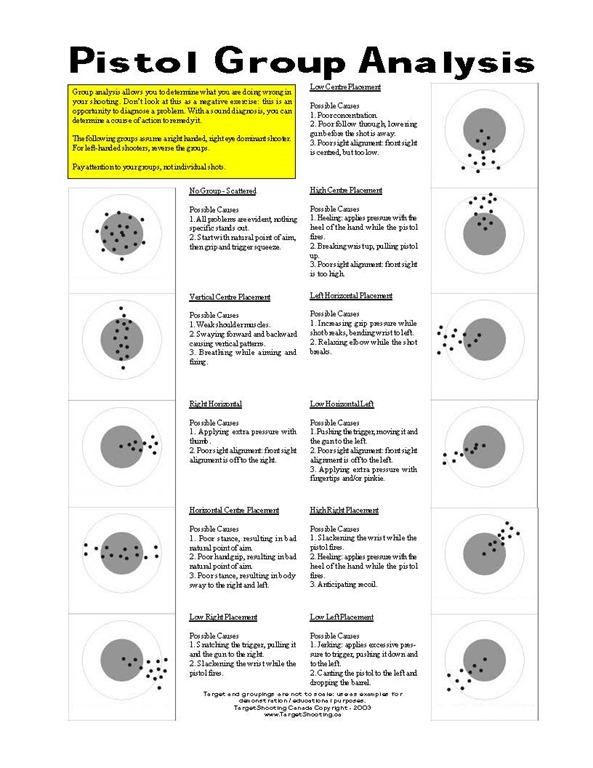
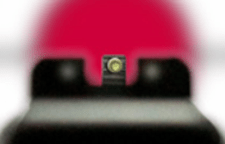
    1. Sight Alignment – This is the alignment of the front and rear sights, so that the front sight is right in the center of the rear sight and the top of the front imagesight is even with the top of the rear sights.
    2. Sight Picture – The top edge of the front sight should be centered on the target, and you should focus on the front sight.
    3. Trigger Control –You need to maintain sight alignment and sight picture while pressing the trigger. Another way of saying it is, once you have your sight picture, your gun should not move while you press the trigger.

    Why are small guns difficult to shoot, accurately?

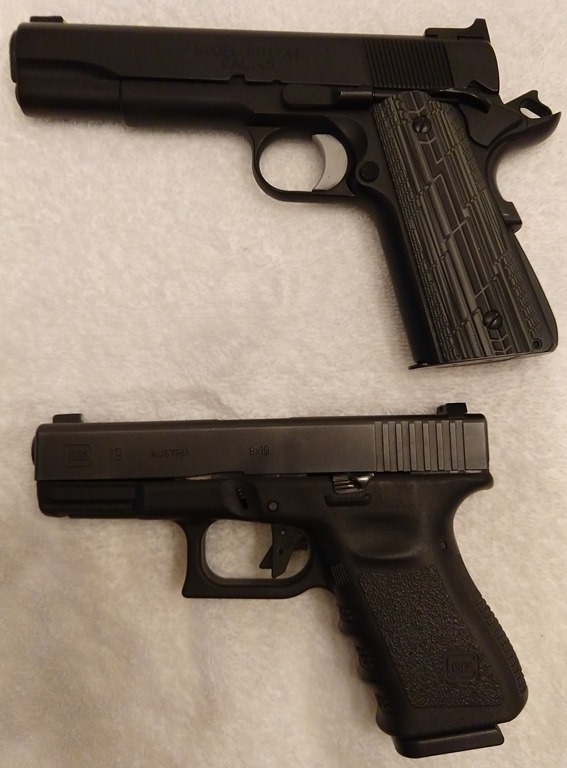
    It is important to recognize that different handguns have many different features and capabilities. For this post, I pulled out four different handguns: The 1911, Glock 19, Smith & Wesson M&P Shield, and Sig P238. All of these four handguns are single stack, except for the Glock 19, which is a double stack. There are clear size differences between the four handguns, and there are also clear differences in how they perform when it comes to accuracy. The 1911, is incredibly accurate, but is probably not what we would all consider the best choice when it comes to a concealed carry handgun.

    I chose these four as they are from different manufacturers, as well as being different sizes. Typically, the industry breaks handguns down to these size categories:

    • Full Size – Some examples include the 1911, Beretta 92FS, Glock 17, Smith & Wesson M&P 9, and other full sized service handguns. These handguns will usually be carried in an outside the waistband holster. While they can be concealed, they can be  challenge to conceal.
    • Compact – This would be the next step down in size. This category includes guns like the Glock 19, Springfield XD 9, Beretta 92 FS Compact, and the Smith & Wesson M&P 9C. Every one of these guns is capable of being used as a concealed carry handgun, depending on clothing and body type. Some people, however, have trouble concealing guns in this category.
    • Sub-compact – The next step down is the sub-compact. Some examples  include handguns like the Glock 26, Glock 43, Smith & Wesson Shield, Springfield XDs, and the Honor Defense Honor Guard. Most of these guns are single stack guns. The Glock 26 is a notable exception, as it is a double stack.
    • Pocket-This category is often referred to as mouse guns. Some examples include the Ruger LCP, Sig P238, and the Beretta Nano. There are many others, and they will use .380 ACP, .32 ACP, and .25 ACP. Almost all newer pocket pistols will shoot .380 ACP.

    The differences between the four handguns include the following attributes that I feel have the greatest impact on accuracy:

    • Sight Radius – Obviously, on larger guns, with longer slides (or shorter barrels if you are talking about revolvers), the sight radius is longer. A longer sight radius is important when it comes to accurate shooting, which is why target shooting guns have longer slides, like the Glock 34 or 17L.
    • Grip Size – One of the keys to accurate shooting is keeping the sights aligned and the sight picture in place while activating the trigger. Getting, and keeping a good grip on the gun during trigger compression is very important.
    • Weight – Larger guns, obviously, are heavier. Well, in most cases that is true.
    • Ammunition – Of the four handguns, we have the 1911 that shoots .45 ACP, the Glock 19 and Shield shoot 9mm Luger/Parabellum, and the Sig P238 that shoots .380 ACP. Different ammunition creates different levels of recoil. The felt recoil can impact accuracy when the shooter starts to anticipate the recoil and jerks the gun in an attempt to minimize the jerking in their hands.

    Note: The trigger and action are significant factors in accuracy, too. There is no doubting that a single action handgun is often more accurate than a double action or a striker fired handgun as it is easier to keep the sight alignment and sight picture with a short and smooth trigger. I am not discounting the trigger and action. While the trigger in a handgun can be improved or replaced, the difference between a hammer fired and striker fired gun can’t really be changed.

    While each attribute comes into play, some of them are much more larger factors. For example:

    • The 1911 uses .45 ACP, but the ammunition is not a significant factor as the weight of the 1911 and its single action trigger more than make up for the ammunition’s impact.
    • The Sig P238 uses .380 ACP, but the weight of the all metal P238 and its single action trigger do not overcome the short sight radius and the short grip length.

    Full size vs Compact

    Compare1If you refer to the picture of the 1911 and the Glock 19, it is clear that the Glock 19 is shorter in length. The longer length of the 1911 provides for a longer sight radius and longer barrel. The 1911 has a longer grip, too. 

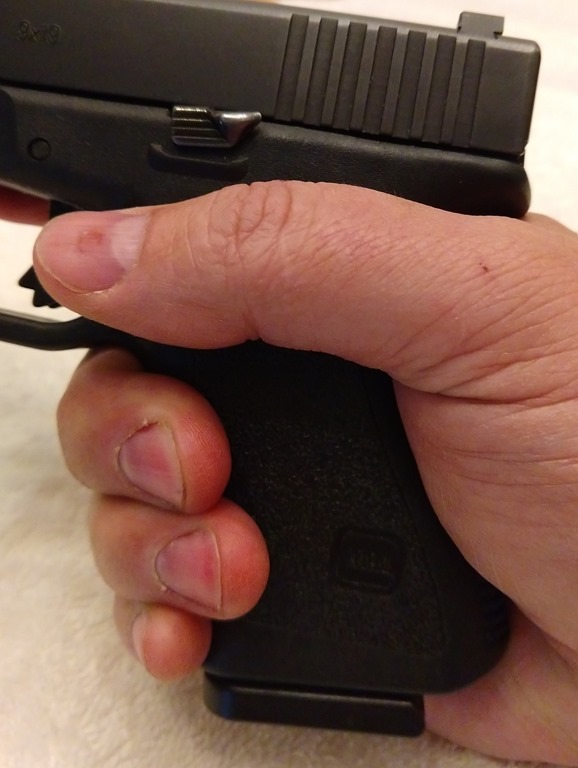
    Of course, the 1911 is also all metal, and it has a single action trigger. When you add up all of the benefits of the 1911, as a full size gun, you end up with a much more accurate handgun, and it is also much easier to shoot even though it uses a .45 ACP as compared to the Glock 19’s 9mm. The weight of the all metal frame helps absorb the recoil energy and makes the 1911 very easy for most people to shoot. While the grip surface of the 1911 is longer, since it is a single stack, it does not have much girth. Compare7Compare5

    While the pictures are not the same proportions, you can see that I am able to get all of my firing hand on the grip of both guns without any issues. The Glock 19 is a double stack, so it is has more girth. The double stack can be an issue for some people with smaller hands.

    Note: Yeah, I need a manicure. My hands are far from pretty with the scars and the nicks and scratches. I should have had somebody with pretty hands for the pictures, but I wanted to get this post done.

    From my personal experience, I can really shoot the 1911, easily, and accurately. If I had to go to the range with some friends and have a shooting competition, i will use the 1911.

    Compact vs Sub-compact

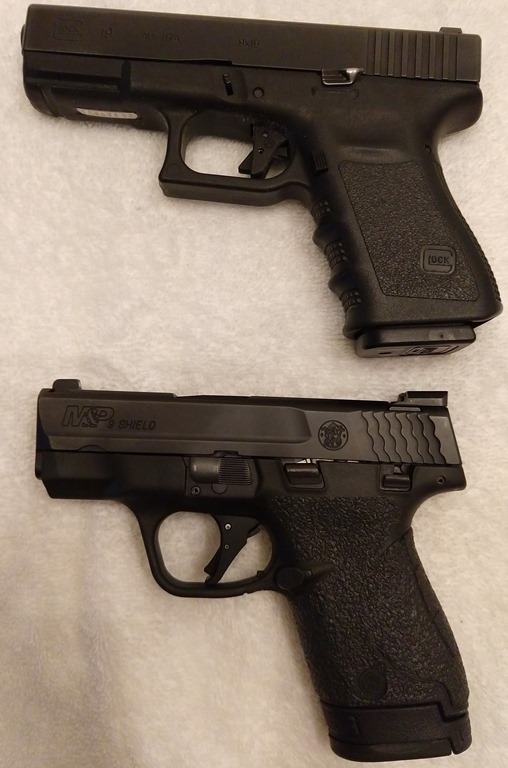
    If you refer to the picture of the Glock 19 as Compare2compared to the Smith & Wesson M&P Shield, it is clear that the Shield is shorter in length. The shorter slide, with the shorter sight radius and barrel, means that it is not as accurate as the Glock 19. At least, that is my experience.

    Both guns have polymer frames, and, in this case, shoot 9mm. Both guns are striker fired, and have similar trigger behaviors.  Those that are experts will probably notice that I have replaced the Shield’s trigger with the Apex trigger and spring kit because I hated the hinged trigger. Some people will also notice that I changed out the trigger shoe on the Glock. I also did some polishing of both trigger components to smooth out burrs. The result is that the triggers are very similar.

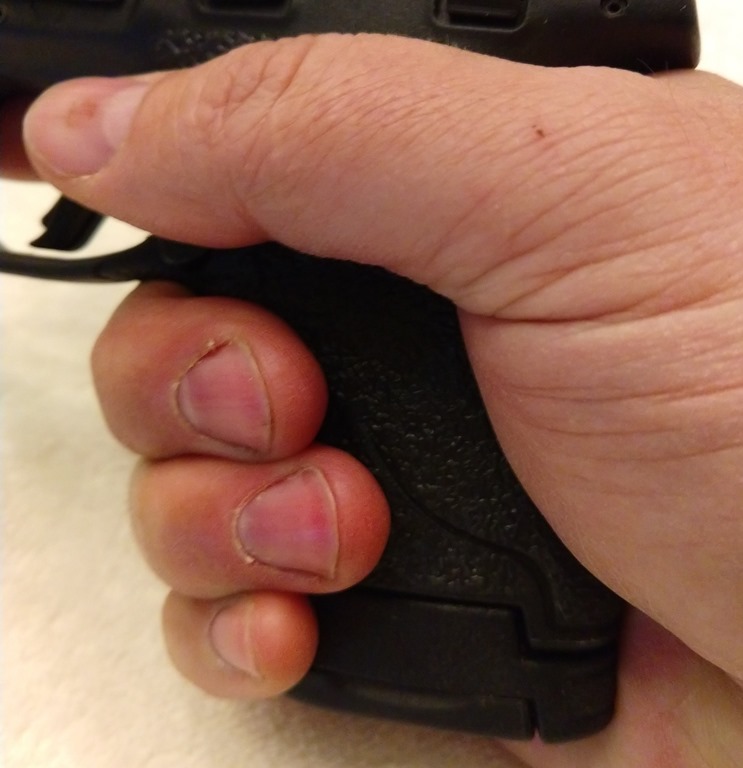
    The Glock 19 is a double stack, while the Shield is a single stack. The Shield also has a shorter Compare4gripe. However, the Shield comes with two different magazines, and I use the extended magazine, as shown, so I can get a good firing grip on the gun. I also added the rubberized Talon grips to the Shield to make it easier for me to hold onto the gun. Because of the extended magazine and the Talon grips, I find the Shield easy to shoot, as well. If I were to go with the Shield’s flush fit magazine, I would not be able to get my pinky on the grip, and would not have as good of a grip on the gun. With the flush fit grip, I find that I am not able to shoot the Shield as well as with the extended magazine.

    Note: I carry the Shield in situations where the Glock 19 tends to print, too much for my tastes. The single stack of the Shield makes it much easier to conceal. I carry the Glock 19 whenever possible because of its larger capacity, though.

    Sub-compact vs Pocket

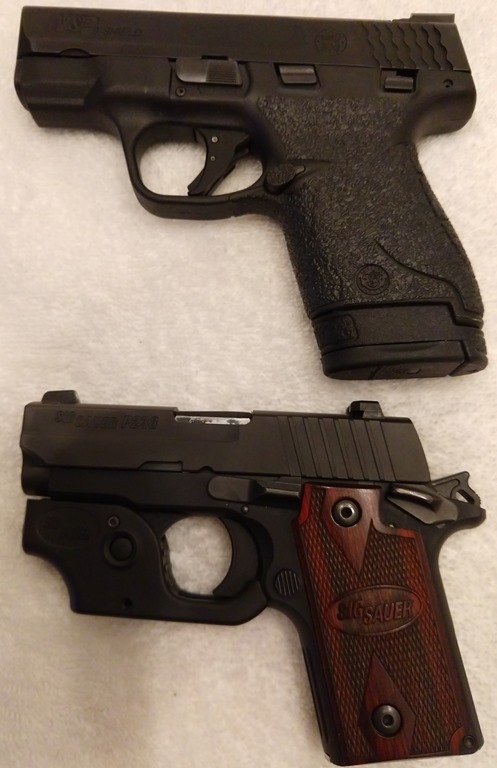
    Comparing the single stack Shield to the Sig P238, shows, very clearly, the Compare3size differences. The Sig’s slide is much shorter and the grip is also much shorter. You end up with a shorter sight radius, and a shorter barrel.

    The big differences are that the Sig has a metal frame, uses .380 ACP, and has a single action trigger. While the .380 is not as powerful as the 9mm, and the metal frame of the Sig gives it more heft, the Sig is actually a great deal snappier than the Shield. The reason that a shooter, especially somebody with larger hands, experiences more felt recoil is the  inability to get a good grip on the gun. With more felt recoil comes the susceptibility to “push” the gun in anticipation of the recoil. While the anticipation can be minimized with lots of practice, the grip will still be a factor in keeping the gun steady while shooting.

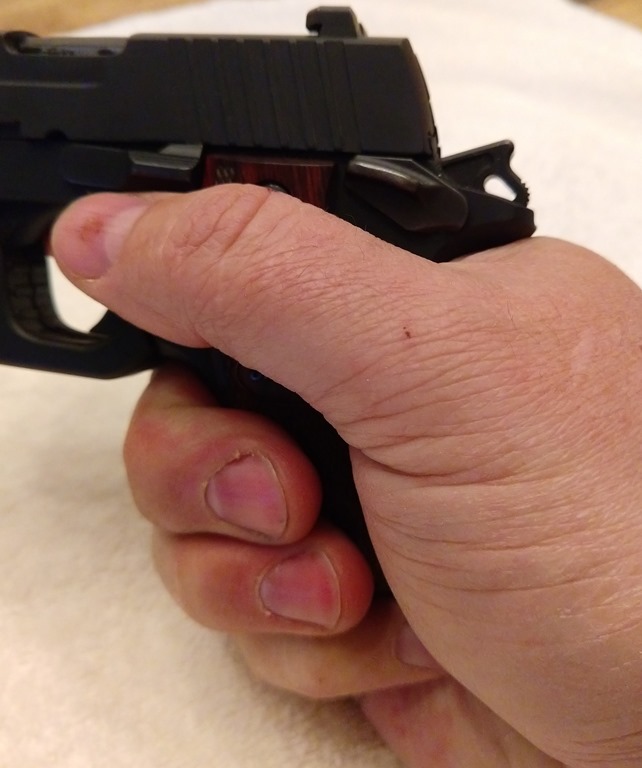
    It is really easy to see the issue with the grip on the Sig when you see how I Compare6can’t get my pinky on the grip. I can barely get my first two fingers on the grip.

    Of course, there is another issue at play when shooting this gun. The trigger is much closer, and it is a bit awkward for my index finger to reach the trigger and operate it as well as the other guns shown in this post.

    While, I have lots of issues shooting the Sig, and other pocket sized guns, accurately, does it even matter?

    Does it matter that small guns are difficult to shoot, accurately?

    Yes, it Does – Of course, accuracy is vital. We have all learned that you have to get good hits if you want to stop the threat. So long as you are using good ammunition and of the proper type, good hits should stop the threat. While there is debate about whether the .380 ACP is good enough for self defense, the .380 ACP, and some other rounds in small guns, will get the job done.

    No, it Does Not – We are not having a bull’s eye shooting competition. Most conflicts occur at very short distances, and getting shots on target is not as difficult as people have been led to believe when at close quarters. After all, we often teach point shooting and using a close quarter retention stance, when shooting at close contact distances. We probably will not get the chance to use our sights until we have gotten some distance from the attacker and have already shot a couple of rounds.

    Summary

    You have to take into account several factors when selecting your gun, and accuracy may not be the most important concern. Oh, yeah, and practice, practice, practice.

  • I Have my Concealed Handgun Permit–What’s Next?

    Many people think that getting the permit is the end to the journey, but it is not even close. Once you have done the minimum to get your permit, the next steps are to become proficient in:

    • Carrying – You have many decisions to make, here, and you have to get good at making sure you have the tool when you need it. The tool is important, but unless you actually have it with you, it doesn’t matter how good of a handgun you have in your safe at home.
      • What handgun will you carry?WP_20171227_15_05_57_Pro
      • What position will you use to carry?
      • What holster will you use to carry?
      • What ammo will you use?
      • Will you carry an extra magazine?
      • Will you modify your gun?
      • What about a light, a knife, and a small first aid kit?
    • Shooting – Training, training, and more training. The key is training how you will carry. That means, if you will carry inside the waistband, that you will train with your gun and holster in the same position. Your shooting should be at all distances and using ammo similar to what you will carry.IDPA Of course, you should test your gun with the ammo you will use to make sure it is reliable in your gun, and accurate. The hardest part of training is trying to make it realistic and to implement IPSCsome pressure into your training. Of course, your typical range will not like it if you are moving, drawing, and shooting, and they will not be providing cover and concealment for you to maneuver as you shoot. This is where competitive shooting comes in and should be incorporated into your training.
    • Understanding the Law – Do you understand when you are allowed to use your handgun in self defense? Hopefully, your training for your permit covered the laws of your state so you understand when using deadly force is appropriate and justified. For example, I own several books, and a subscription to Lexis Nexis so I can review the actual laws and some of the related cases.
    • Understanding Legal Repercussions – The aftermath of using deadly force is also a key part of what you need to learn, and how to handle the aftermath. Do you understand that you will be arrested, in many cases, even if your shooting was justified? Do you understand how much defending yourself will cost and the risk of being incarcerated? Hopefully, you have purchase some good concealed carry insurance from a reputable company. There are many good insurance programs out there. I would recommend that you dig into each of them and keep away from those that only provide reimbursement for the majority of your costs after you are found not guilty or your charges are dismissed.

    Summary – Please, oh please, understand that there is much more than just attending a class and getting a permit to carry your handgun. Shooting is a very perishable skill. You need to keep training to keep up your new skill, but you also need to do much more than just go out to your local range every few weeks.

  • Chamber a Round?

    A common question and misconception when it comes to every day carry is imagewhether carrying your handgun with a round in the chamber is risky. Negligent discharges (NDs) happen when a gun is fired because of the negligence of the person in carrying and handling the gun, inappropriately.

    NDs – Common Causes

    • Not using a holster – The trigger is exposed and can be activated by foreign objects that get into the trigger guard. Carrying in a pocket or a purse without some kind of holster can increase this risk. The trigger guard should always be completely covered by a quality holster, even if the gun is inside a purse or pocket.
    • Using a broken holsterWorn out and broken gear can cause a ND. It is the owner’s responsibility to inspect equipment and replace it as needed.
    • Holstering without proper care – NDs often happen during holstering your gun when you don’t watch for objects that might get into the trigger guard, like concealment garments. Too often, people slam their guns back in the holster without taking due care. There is never a need to holster, quickly.
    • Using a poorly designed holster – The holster should be designed so that it is easy to keep your trigger finger away from the trigger guard. The holster needs to be made of quality material that protects the trigger.
    • Poor trigger finger discipline – Rule 3, keep your finger off of the trigger until you are ready to shoot. You need to train and build automaticity when it comes to trigger finger placement. This point can’t be emphasized enough. Finger off of the trigger until you are ready to shoot.

    The Arguments

    There are several arguments around this topic. 

    • Draw Stroke – Proponents of not chambering a round say that adding the step of chambering does not increase the time for a draw stroke very much. That is true, it only add a split second, if you have practiced it, over and over and over. However, that split second can be the split second that makes the difference between life and death. Proponents of not chambering a round like to say that the extra split second won’t make a difference in most cases. So, yeah, the proponents of an empty chamber are basically saying that they are depending on probability. Probabilities are not the basis of the decision to carry a gun. The decision is made because we value our lives and the lives of our loved ones enough that we choose to mitigate those slim probabilities with our decisions.
    • Short Stroke – What you will see, if you watch enough videos, is that when under pressure, it is very easy to short stroke the slide and fail to chamber a round when you absolutely must be successful. The stress and pressure of needing to chamber a round, quickly, can results in the shooter not pulling the slide all the way to the rear, and when it moves forward, it doesn’t pick up a round from the magazine and load it into the chamber.
    • Support Hand – Chambering a round during the draw stroke requires that your support hand is free. However, we will see, in many videos, that defensive shooters end up using their support hand to try to gain space from an attacker or to move them off of the mark. To be fair, we should all train to run our guns with one hand as we might become incapacitated. However, the plan to have the hand free may just not be possible to implement.
      NOTE: Be prepared to throw your phone down if you have it in your hand and you need to draw your gun. It amazes me how people just won’t drop that ever present phone.
    • Excessive Handling – NDs happen most often during holstering and un-holstering. It may make some sense in law enforcement where officers are required to un-holster and clear their gun at the end of their shift, then load and holster, again, at the start of the next shift. For a concealed carry person, however, it is simple to take off our holster, with the gun in it, and never expose the trigger and trigger guard to foreign objects and poorly disciplined trigger fingers.
    • Training – Israeli carry, the common term used, has been taught by some militaries and by some law enforcement agencies. The reason it is taught is fairly simple: They do not have the resources to property train and instill best practices. Israel, for example, has many short-term conscripts and rapid turnover of personnel, and it is a never ending process to get them through some basic training in handling firearms, safely. It is best to keep them as safe as possible, and the investment in high levels of training with handguns just doesn’t make financial sense.
    • Old Guns – Some older handguns did not have drop safeties. To overcome the risk of the gun firing if dropped, leaving the chamber empty was a good mitigation for the problem. However, no responsible concealed carrier would use an older gun without a drop safety.

    Probability

    I often hear people say that they don’t carry with a round in the chamber because of the probability of a ND.

    To me, it makes little sense. We choose to carry a handgun to protect ourselves and our loved ones from threats to our lives or serious bodily harm. We make this decision despite the probability of it happening being incredibly slim. The odds are long that we will have to use our handgun in self defense, yet we make the decision to protect ourselves in those cases. Why would we choose to make it more difficult to deploy our gun in the event it is needed?

    So, we have already made the decision to protect ourselves against some incredibly slim odds of a threat occurring. Yet, even though it is possible that we will not have time to draw and then rack the slide to chamber a round, some people will choose to include the time and effort of chambering a round and the risk of not being able to complete the process and then get good hits on the target before it is too late.

    There are a couple of statements that I have heard that really bring the point home:

    • Trying to chamber a round when you absolutely need to bring your gun imageinto the fight is like trying to put on your seatbelt right before the impact of a car crash. It is too late!
    • Trying to chamber a round might be the last thing you “try to do” and you have until the end of your life to keep trying.

    Malfunction

    In the past, I have covered malfunctions, and I will do that again, soon. In the case of not carrying a round in the chamber, you have basically chosen to start off any highly stressful situation where you need to use your gun with a Type 1 malfunction, and you must clear it before you can actually defend yourself.

    If you understand malfunctions and malfunction clearance, you should recognize that this is an incredibly bad situation. By choosing to not chamber a round, you are giving yourself the handicap of starting off with a malfunction. You are choosing to have a broken gun.

    Solution

    The solution is incredibly EASY.

    • Holster – Buy and use a quality holster.
    • Train – Train, and train some more, so that you have great trigger discipline. Trigger discipline needs to be burned into your brain so that it becomes instinctual. Keep training to keep your confidence levels high. Every single time I draw, or pick up, a gun, my trigger finger will be well away from the trigger until I am sighted in on my target and ready to shoot.
    • Gun in Holster – Keep your gun in its holster. Take off your holster with your gun inside it. Put your holster on, with your gun in it.
  • Should I Carry an Extra Magazine?

    Short Answer

    Yes

    Longer AnswerLoad Semiautomatic

    Yes. There are several reasons that you should consider carrying an extra magazine with your every day carry (EDC) gun.

    Many people will say that capacity is everything. Others will say that good shot placement is vital, and that is why we train. Both are right. When it comes to capacity, nobody knows just how many rounds might be needed when that really bad day rolls around, and no matter how many rounds we have, you still need to get good shots to stop the threat(s). However, there is more to the discussion that “more is better,” and it is a good idea to outline some of the discussion points.

    Small EDC capacity – Many people carry smaller single stack hand guns, and the single stacks have much smaller capacities as compared to larger double stack hand guns. I think an extra magazine is probably more of a need for those that carry single stacks, especially the smaller concealed carry guns like the Smith & Wesson Shield and the Glock 43.

    Motivated assailants – I wish I could find the video that I saw a couple of years ago about OC spray. It was really interesting because they were able to show that if the person was motivated enough, they would easily continue despite being sprayed in the face. They had about five people, and told them that if they could get to the table and perform a simple task, after being sprayed, they would get a nice sum of money. Every single one of them could do it. We have seen some really motivated attackers that just continued to absorb shot after shot and kept on coming. If you want to see how a motivated attacker will just keep coming, just watch the video of the Minnesota mall stabbing attack where the officer that killed the attacker had to shoot him several times. We just don’t know how many rounds might be needed to properly dissuade an attacker or stop them, completely.

    Drugs – I think it is pretty clear that mind altering substances can prevent the pain center from providing the “F#CK, I have been shot” response. FIBS is a nice acronym that John Correia uses. I love it. Anyway, under the influence of many different types of drugs, an assailant may continue, even though another person would have already died. So, again, we just don’t know how many rounds it will take to stop the threat.

    Multiple assailants – I point out, often, that bad guys have friends that are also bad guys. They like to work in groups as it gives them an overwhelming advantage in an altercation, and they seem to be braver when they are in groups. How many shots will it take to stop multiple attackers? Again, we don’t know.

    Average shots in defensive gun use – The stats are out there. The super tactical Internet ninjas will tell you that the average defensive gun user will only shoot X number of shots. So what? Yeah, I said it. Since when do we make decisions around our lives based on averages and other statistics? If we really made decisions based on stats, we would never carry, because the stats show that we will probably never need to draw our handgun and use it. I made the decision to not bet my life and the lives of my loved ones, based on some statistic, so why would I choose to not carry an extra magazine because of some statistic?

    Stress  – I think it is clear that if you ever need to shoot somebody, the adrenaline will be kicking in, and you will not react like you would on the range. You might draw your gun, and fumble it a bit, and accidentally release your magazine onto the ground. You will very likely not be nearly as accurate when shooting as you would be on the range, either. Actually, many trainers refer to it as the rule of 50%. You will be lucky to be 50% as good as you are, normally, when that stressful situation arises and you have all of that adrenaline flooding through your body. You might, normally, only need a controlled pair to end the threat. However, your controlled pair will not be very well controlled, and you will probably miss.  Need further support for the impact of stress? Do a little research on Police accuracy in similar situations.

    Range targets don’t bob and weave – I have yet to see a target on the range duck. Even the best targets don’t bob and weave and duck while you shoot at them, but real people do. I don’t remember there being a rule that assailants have to stand still. If there is such a rule, I don’t think they will abide by it. So, again, that controlled pair may not even hit your target, and you won’t know how many rounds it will take to get good hits and stop the threat.

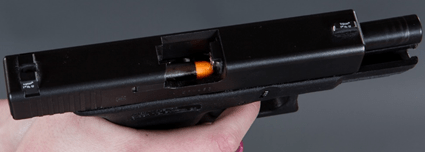
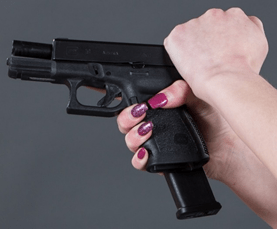
    Malfunctions – Mr.  Murphy will appea0957-0199r at the worst time. That gun that has never had a double feed, ever, will pick that moment to have a double feed. I hope you learned how to fix a Type 3 Malfunction. If not, you should pay somebody like me to teach you. The solution to fixing your malfunction will be best solved by getting a different magazine into your gun so you can continue firing. While your Type 3 malfunction might look like the one in the picture (I hope you are using real defense rounds and not inert rounds like in the picture), you will need to fix it, quickly.

    Summary

    Each situation is different, and nobody can predict how many rounds you will need, or whether you will have a magazine related failure, when Murphy shows up during that one time when you need your gun to work, flawlessly. That extra magazine may be the deciding factor on that really bad day in your life and whether you will have more days in the future.

  • Blackhawk Serpa Holster

    I have two of these holsters. One, I bought to demo in my classes, the other actually was used by one of my sons, on rare occasions, when riding around Blackhawk Serpa Level2 Sportsteron our UTV on our ranch. Yes, it was used, but it was not carried in the real world, only on the 10,000 acre ranch to make sure the gun wasn’t lost. Of course, now, he uses a much better holster.

    I do not like it, and for good reason. So, let’s review a previous blog about holsters. In that blog, I stated that a good holster will have the following features:

    • Ease of Carry – A holster allows us to carry our gun on our body so that it is as close as possible in the event we need it.
    • Retention – One of the biggest fears of a conceal carrier is that you will see your gun skittering down the hallway of your office or some other public place. Keeping the gun in the holster is important. Also, retention, passive and active, helps keep the gun safe from a potential gun grabber. In other words, the holster needs to keep the gun in the holster until you need to access the gun.
    • Trigger Protection – Proper carry requires that the trigger be protected so that other objects can’t accidentally activate the trigger and cause a negligent discharge that might harm/kill you or others that are near you.
    • Protect the Gun – We tend to forget that a gun is susceptible to sweat, lint, and whatever else you might contact that can scratch the surface treatment and cause corrosion. A concealed carry gun gets lint, even in a good holster, but using a holster that doesn’t keep your gun separated from the environment will lead to greater exposure to corrosive elements and general dirt and lint.
    • Stability of Position – We need our gun to be held so that it is stable and doesn’t bounce around as we move around through the day and night. It is also very important that your gun is in the same place with the same cant every time you train with it and carry it. You need to practice, over and over, and build automaticity can, reflexively, draw your gun when it is needed.

    Now, that we have gone over the review, let’s talk about what is wrong with the Serpa.

    • Recognized Safety Issue – While on the surface, the Serpa looks great as it provides active retention, it is the retention design that is a huge safety issue. A quick search on the Internet will provide several examples of issues with the Serpa. The fact that the Federal Law Enforcement Training Center (FLETC) has banned them should be enough. After all, if the Government finds something to be unsafe and takes action when they are the last to ever take action, that should tell you something. There have been many incidents where people have shot themselves when using this holster. In one particular incident, Tex Grebner shot himself when using the Serpa. Many people stated that it was a training issue and that Tex, like many others, needs to properly train with the holster and use it properly. Tex, like others, found that the finger that is used with to deactivate the retention device aligns very closely with the trigger of the gun in the holster, especially when trying to draw, quickly. It is fairly easy to replicate what happened to Tex. Watch the video. Please! While Tex, today, does not blame the holster, many of us do.
    • Retention Device Failures – The other issue that has been discovered is that dirt and other debris can get into the retention paddle and disable it by clogging it up. It happens way too often. With a little dirt or small gravel pieces underneath the retention paddle, it will not depress and you can’t get your gun out. Obviously, this is a concern for those that may need their gun at that moment.
    • Poor Construction – The material is not kydex. It is injection molded plastic and does not have the strength of a kydex holster.

    John Correia posted a great video on this subject, earlier today. While I have previously posted about the Serpa in previous blogs, I felt it was worth mentioning again. Please view John’s video. It is well worth the time. In his video, John says that the following issues exist:

    • Safety
    • Flimsy construction of the belt attachment device
    • Debris can prevent deactivating the locking mechanism
    • Locking mechanism can not be inspected or cleaned
    • Many other options available around same price
    • Locking mechanism easily deactivated when fighting for the gun

    Banned – This holster has been banned by pretty much every private training center in the US and has been banned by many large police departments. The reason is that it is not safe enough. Again, refer to FLETC and their banning of the holster.

    Support for it – This holster, for some reason, has a strong group of supporters. Why? I don’t know. But, they are not about to admit that they made a bad choice when they purchased it, even if they did not know what they should know, now. I about lost my mind the other day when somebody said, “I have carried with it for years and never had a problem.” Well, you know, I heard that crappy logic before from a relative that told me, “I have been drinking and driving for years and have never had an accident.” Yes, it was said. I don’t think I have to explain that just because you have been lucky doesn’t mean that you will continue to be lucky.

    Summary

    Don’t buy this holster. If you have one, keep it and use it to show your friends what not to buy before they buy their first gun and holster. If you see people wearing one, stand far away from them.

  • What Gun Should I Buy for My Wife for Conceal Carry?

    I hear this question way too often. There are a couple of problems with this question. The biggest issue that I have with this is that somehow, many men think they know what women need. Yeah, I know, that whole issue about what women need is a big issue for men, in general. Smile

    Luckily, there are some really good women out there that understand that the male focused industry has done a horrible job of meeting the needs of women, and those same women have gone out and done some great work trying to get a good idea of what works best for women. I will get to the articles in a minute, but first, here is my take:

    • Let women make their own decision.
    • Let them try out several different guns and see what they like best and can shoot best. The best place to do that is at a range that rents several guns.
    • Make sure they get some basic training in safety, first.

    This year, the American Rifleman (yeah, I get the irony of the “man” part of it Winking smile) published two great articles on the topic.

    The first one The Ladies Pistol Project is a great starting point. TheLadiesPistolProject idea was to define what a female friendly handgun really is, according to women, not according to some marketing guys that work for gun manufacturers and think that making it pink makes it something that will work for women.

    Basically, women like guns that fit them well and that they can shoot well. Sounds like the same thing that men like.

    The one item that really caught my eye was that so many women did not like the smaller J-Frame revolvers. I have always felt that they don’t work as well for women as men believe. I felt vindicated when I read that.

    The second part of this project was The Ladies Pistol Project II – Concealed Carry Pistols. This is another great article where several women got to shoot and rate several conceal carry pistols to see what they liked best. Again, there were some great results from the project that I encourage everyone to read.

    Summary: It isn’t about the color of the gun, as many marketing people seem to think. It isn’t about being able to rack a slide, as we have seen from the survey results from women. It is about comfortable with the gun and being able to accurately shoot it.

  • Glock 19 vs Glock 43–Concealment

    OK, this isn’t a shoot off or anything like that. I just heard somebody state that a Glock 43 with a magazine extension is the same as having a Glock 19 when it comes to concealability.

    Yeah… no.

    I happen to have a Glock 43 with a +3 mag extension from Taran Tactical, and a Glock 19 with a stock magazine, we can easily compare the two guns side by side.

    Concealing a carry gun involves several factors.

    • Height is the distance from the top of the slide to the bottom of the magazine.
    • Length is the distance from the end plate of the slide to the muzzle, and will also include the rear of the grip if it extends past the end plate.
    • Weight – well, all of us understand gravity and its impact on everything.
    • Capacity of each gun will differ, and capacity will impact concealment by adding weight and size. It is, absolutely, a trade off.
    • Capability of each gun differs, but only very slightly, and it really doesn’t impact concealment.

    Let’s look at each of these factors.

    Height – With the extended +3 mag, which is pretty much one of the larger WP_20171028_15_12_22_Pro (2)WP_20171028_15_12_43_Pro (2)ones out there, the measurements are pretty interesting. The Glock 43 from top of the slide to bottom of the extended mag is just under 5 1/8”, not including the sights. The Glock 19 is just under 4 7/8”, not including the sights. So, with the super big extended mag the Glock 43 is about 1/4” taller. Pretty negligible.

    Length – Obviously, the Glock 43 will have no change from stock with the WP_20171028_15_10_04_Pro (2)extended magazine. The length of the Glock 43 is a touch over 6 1/4″. The Glock 19 is a bit over 7 1/3”. So, well over an inch in length difference. It is pretty clear that the Glock 43 is much smaller.

    Weight – I don’t have a scale nearby to measure the Glock 43 with the extended mag, but I am certain that it is safe to say that it is less than the Glock 19. I doubt anyone would argue that, but if they leave a response, I will make sure I verify. The local grocery store is starting to get used to me weight hand guns by using the fruit and vegetable scales.

    Capacity – There is a big difference here. The Glock 43, with the extended +3 mag, puts it at 9+1. The Glock 19 is 15+1. Obviously, concealability is very important, so we see single stack guns like Glock 43 holding fewer rounds than double stack guns like the Glock 19.

    Capability – There is a difference in sight radius (thus, accuracy at distance) and bullet velocity. The Glock 43 is on the short end of each of those measures. However, as a defensive gun used in close quarters, those measures don’t mean anything at all.

    Summary

    The difference in concealability is really measured by the eye of the beholder.WP_20171028_15_14_52_Pro (2) Which of the two guns will print more and which impacts the lengths that we have to go to as a concealed carrier? I can speak from experience, I have to go with my extra baggy jeans to carry my Glock 19, but I really don’t have to change my clothing style to carry the Glock 43. Yes, I have to give up capacity, but that is really all I lose. So, maybe I should carry one more mag when carrying the Glock 43. Smile

  • What is the best holster for … ?

    What is the best holster for open/conceal carry for gunX? I have seen this question asked at least 100 times in the last year on one gun forum or another, and I have been asked this question by family, friends, students, and colleagues about 20 times this year.

    It is important to note how the holster will be used. Inside waistband (IWB) WP_20170926_21_01_08_Pro (2)and outside waistband (OWB) usually refers to a holster that is worn on the strong side. Appendix inside waistband (AIWB) is fairly clear, too (see picture of an AIWB holster). There are many other methods such as bottom of back (BoB), shoulder holster, chest holster, and off body carry. For example, if somebody is back packing and needs ready access to a gun in case of a bear or mountain lion threatening or attacking them, then a chest holster makes lots of sense. The kind of gun and the size of the gun can make a difference in holster choice, too.

    Holster Requirements

    I have given this a great deal of thought over the recent years. I have also done some reconsidering of those thoughts in recent days.

    I believe that the following features should be considered requirements for safe and reliable use:

    • Ease of Carry – The main reason that we use holsters is because a holster makes it easy for us to carry our handguns. Every quality holster should make it easy to for us to carry the gun. The holster has to be easy to put on and take off while being easy to wear every day. A minimal level of comfort is required, or we just won’t use the holster and may choose to not carry.
    • Stability – The gun needs to be held in a stable position so imagethat it is in the same place every time you reach for it. It is pretty hard to build automaticity (again, I promised that I would start using this word) if you can’t practice over and over and find your gun in the same position every time you reach for it without looking. This means that the gun needs top quality loops or clips that will hold the gun and holster, securely, on your belt. For example, if you look at one of the clips on the AIWB holster shown, you can see that it is secured with two screws to the holster and it is made of metal. With two clips holding the holster on the belt, it is incredibly stable.
    • Retention – The gun needs to stay in the holster until you draw it. Passive and/or active retention is vital for every holster. For those that have had the experience of seeing a gun skittering down a hallway because it came out of the holster, it makes you cringe to see it. Skittering syndrome is very ugly. Your gun needs to stay in that holster, even during strenuous physical activity. You should probably roll around on the floor with your gun (unloaded, of course, until you are confident in the holster) in the holster, run around a little, do some jumping jacks and burpees, and perform some other daily activities to test your holster’s retention. Also, retention needs to be considered as part of your defense against gun grabbers. Kydex, especially when it is well formed to the gun (see picture of the imagekydex molded around the trigger guard), provides excellent passive retention. There are also many good holsters that have active retention devices that must be deactivated for the gun to be drawn from the holster. By the way, I don’t like the holster shown here as it does not completely cover the trigger guard.
    • Protect the Trigger – The trigger must be covered so that it is not possible for other objects to get into the trigger guard and activate the trigger. The trigger also needs to be protected from the holster, itself. We have had some reports of holsters actually causing negligent discharges because the material of the holster got into the trigger guard during holstering.
    • Protect the Gun – When we carry a gun in a holster, it is likely that we will, accidentally, bang the holster and gun into other objects like door frames, desks, shelves, and so on. A holster should protect our gun from day to day beatings. Sweat and flaking skin cells (yuck!) can have a severe impact on your gun, too. One of my friends was showing me his gun, and when he broke it down, it had belly hair in it. Kind of gross, and unlikely to prevent the gun from firing, but the impact of sweat (salt water at a warm temperature) can lead to rust. Lint and other contaminants can gum up the action of a gun, even though it might take quite a bit of it. You can protect your gun just by covering it with a holster.

    Elimination Round

    First, the elimination round. I have seen way too many fad or gimmick solutions that just don’t meet what I see as some of the bare requirements for a quality holster. For example:

    • Clipdraw – Anyone who knows me knows how much I despise the Clipdraw, and other devices like it. There are many issues with this product. Even the manufacturer says that you should not carry with a round in the chamber so you can prevent negligent discharges. If you aren’t supposed to carry with a round in the chamber, what does that say about the device?
    • Serpa – The Blackhawk Serpa is disliked by many because it is promoted as an active retention holster, and many people think it is awesome with its lower price, but those that know of its reputation can’t support its use. The Serpa is well known as a poorly designed holster. The retention paddle is easily jammed by dirt and debris, and the way the release paddle aligns with the trigger finger when trying for draw too quickly can result in a negligent discharge. This holster has been banned at pretty much every single large training center in the country, including the Federal Law Enforcement Training Center.
    • VersaCarry – This device, just doesn’t measure up. It, actually, fails to deliver. As with the Clipdraw and the Serpa, I am far from the only one that hates this device. The poor protection provided, and the plastic piece that is inserted into the barrel should scare you away. If you are not scared of it, please research it. You will find it isn’t worth the risk.
    • MIC – The MIC holster covers the trigger guard, but that is about it. There is no secure method provided to hold that gun in position. There is no protection for the gun. I also dislike that the MIC relies on a string wrapped around your belt to separate the MIC from your gun when you draw your gun.
    • Others – There are many others that should just jump out at you as not being good devices or holsters, i.e. the Urban Carry Holster, when it comes to carrying your gun. Please ask around before using them, but, at a minimum, read through the rest of this blog so you can better evaluate a holster before using one out there on the street.

    Evaluating Holsters

    If the holster meets the basic requirements, as discussed, above, I will take the next steps when it comes to evaluation. I have always looked at holsters using a few different criteria, above meeting the minimum requirements of a holster, before buying one. Even then, I still have way too many holsters sitting in a box in my closet because they just didn’t work out for me. Here is what I tend to look at when buying a holster:

    • Material – Kydex is king. Leather can be good, too, and I have used a couple of leather holsters, in the past. Kydex and leather, combined, make for some good hybrid holsters. There are lots of good hybrid holsters out there. Stay away from nylon holsters, injection molded plastic, and anything that uses strings. If using leather, make sure it is stiff and uses double/triple stitching at stress points. Durability is as important as retention when it comes to the materials used.
    • Comfort – Keep in mind, very few people are ever comfortable with a new holster because it just doesn’t feel right. It is like a new pair of shoes. You need to get used to them. It takes time to get used to a holster. After all, if you can’t carry comfortably, you will be tempted to not carry as much as you should, or not at all. So, comfort is important. I have found that some holsters, like Alien Gear and Stealth Gear, are incredibly comfortable right out of the box (OK, really they arrive in plastic bags). Kydex holsters can take some time to get used to them. Give them a chance.
    • Functionality – You need to be able to draw your gun from the holster, with ease. The gun must be drawn, rapidly, and safely, for the holster to have any value, at all. Some holsters are difficult to access. Also, it is important to note if any of the retention devices are hard to operate or if the front sight catches on the holster. Another example, you shouldn’t have to twist your gun while drawing it, for it to come out of the holster.
    • Adjustability – Sometimes we need to adjust the cant of a gun, or the depth that it rides as it compares to our belt. It is vital, for example, that we can get a full firing grip on our gun when drawing it from the holster.

    Recent “Re-Thinking”

    I have lumped all minimalist holsters together, in the past. I blew up Glock Nation, recently, and was barraged with insults (some of the insults were really entertaining) when I discounted a particular holster based on my thinking around minimalist holsters. BTW, those that insulted me had no clue about my background and abilities, but I have a thick skin, so no worries. Not all perception is reality.

    As I have always stated, my main issues with minimalist holsters have been:

    • Stability – The gun needs to be stable on the body. It needs to stay where you put it.
    • Protection of the Gun – The holster needs to protect the gun from being smacked around and from being exposed to the body’s sweat and skin flakes.
    • Training – It is really hard to built automaticity if you can’t draw, fire, then holster the gun, repeatedly. Building automaticity is hampered by the heat of the barrel and slide after firing a few times.

    A Glock Nation member recommended this holster, the VEIL Ghost (shown here), and I was quick to discount it, a little too harshly and without really researching it well enough. The reason that I discounted it was that I didn’t like the belt loop and I didn’t like that the slide was exposed and not protected by the holster.

    A couple of members stepped in and pointed out that the holster was very stable with the right size loop to match the belt width, but that it was also available with a good clip instead of the loop, which would meet my requirement. The claw device, and an optional bump are also available, and they would increase stability while also improving the concealment of the holster. The clip was the key to me, though. Another person demonstrated their use of this holster and that there were no issues with training with it, especially if you use an undershirt to give you a layer of fabric between you and the slide of the gun. The other part of protecting the gun is from banging into things. Well, that is not an issue, either, when carrying AIWB. People just don’t bang that part of the body into door frames and desks. Well, at least, I don’t. Smile

    Anyway, I thought long and hard about this holster, and some of the others like it. I decided that they, definitely, should be considered. This kind of holster should not be lumped in with the MIC and other minimal holsters as it offers much more than they do. I haven’t ordered the Ghost, yet, but it is on the short list of holsters that I want to try. I appreciated the professionalism of those that took the time to address my concerns. I also took the time to make sure everyone knew that I was reassessing my point of view on this holster and others like it.

  • Handheld Lights

    I will start off with a quick story. I have always recognized the value of handheld lights for searching for the source of noises. I started using handheld lights, long ago, when a friend of mine made the horrible mistake of using his weapon mounted light to check the noises in the bushes while he was walking his dog. He found a neighbor, who’s dog was watering the bushes. He also pissed off that neighbor because he was pointing his gun at him. He narrowly avoided the call to the police, but he really damaged his reputation in the neighborhood. He was lucky.

    Fast forward to a seminar I attended last weekend at the NRA Carry Guard Expo. Jeff Gonzalez presented a seminar on handheld lights. After the seminar, I thanked Jeff for the great information and said that I still wasn’t buying that a handheld light can be used to blind or disorient somebody. One of the other attendees said that he could prove it to me. He took a step back, and quickly flashed me in the face with his light. OK. I was wrong. Damn! I threw my hand up in front of me to fend off that evil flash of light.

    Background on Light Levels

    I am odd as I was really interested in the whole concept of different levels of light and how they impact us. Jeff discussed three different types of natural light. Some of you may not care, but since I am writing this, I get to decide what to write.

    • Diurnal – Humans have two types of of receptors in the eye, rods and cones. Rods are more sensitive to dim light but do not provide good color depth and they provide course images. Cones provide sharper images and good color depth. There is a point when light is too dim to see color, and we are only able to see in black and white.
    • Mesopic – Low light, but not quite dark times fall in this category. For example, most outdoor lighting and traffic lights provide this kind of light. Mesopic is between the Photopic (where there is good color discrimination) and Scotopic levels where it is all black and white.
    • Scotopic – The lower extreme of lighting conditions exclusively using rods and your vision, if any, is in black and white.

    Why do we care? Well, it is hard to be a good witness when we don’t have clarity of vision and our eyes are not receptive to the color spectrum. It is also hard to get a good sight picture when trying to use a handgun in low light conditions.

    The Light Beam

    There are three parts to the typical flashlight beam:

    • Hotspot – The center of the beam which provides the strongest light.
    • Corona – The area between the hotspot and the spill/wash of the light.
    • Spill/Wash – The outer portions of the light beam.

    Impact of Light

    As was made clear to me, the human eye is very sensitive to light. Damn! If ILightBeam close my eyes, I can still see the spots. How we react to the introduction of over powering bright light is important. In a defensive situation, the person that we flash in the face with our light will suffer the effects and respond by:

    • Closing their eyes
    • Turning away from the light
    • Blocking the light with a hard or some object

    Bright light can even be painful. Yes, I promise you that is true.

    Side Note: The Wife and my oldest son also got the experience of an intense beam to the face when I got back from the conference. I had to share. Smile

    Use of Light

    As defensive gun users, we use light in a few ways.

    Target Identification – The most common use of a light in a defensive WP_20170830_18_41_17_Prosituation is to identify the target and verify the target before shooting or taking some other action. We have all heard the stories of the teenager or some other family member coming in late at night and being shot as a suspected intruder. It is vital that we identify the target before shooting.

    Search – We saw the bad guy, and he evaded us. He might be in the basement or in another room, so we need to search and make sure that the area is clear. This, by the way, is a great use for a weapon mounted light, too.

    Investigating – We heard noises, and we need to see what cause the noise. This is where we should never use a weapon mounted light. Ever. You should never point the gun’s muzzle at something we are not willing to destroy (Rule 2!). It is easy to explain away a flashlight to the face when it is just a flashlight by saying, “Wow, sorry, I didn’t know it was you. Sorry about that!” All will be well with your neighbor, but you can bet all will not be well if you are pointing a gun at them.

    Pre-Handgun Deployment – In the case we are investigating, and we find a bad guy, we have the light in hand to use while we deploy our handgun. The light can be used for disorientation, as an improvised striking tool, and the wash of the light can be used to monitor the hands of the potential attacker while the light is shined at their face.

    Choosing a Light

    Power – Generally, lumens is the best measure of the output power of a flashlight. The general consensus is that 80 lumens is enough to temporarily blind somebody. However, today, most manufacturers recommend a minimum of 200 to 300 lumens. I know several instructors that recommend at least 500 lumens. The higher power, the lower the battery life, so there is a balance to be achieved. A good light is not expensive. The light shown in the attached pictures cost less than $30 and is 320 lumens. It is more than powerful enough, and if you don’t believe me, ask my son and my wife. They will tell you.

    Some examples, for comparison:

    • 100 Watt Incandescent Light Bulb – 1600 Lumens
    • Car Head Light – 700 to 1200 Lumens, and more for some
    • 60 Watt Incandescent Light Bulb – 800 Lumens

    Note: Lumens can be measured at the emitter or out the front of the device. Out the front is a better comparison as light is lost by the lenses of many devices. While not perfect, most companies use lumens as it is a better comparable measurement than most others.

    Size – The size of a good handheld light can be fairly small and fit easily in a pocket and be held in a hand, covertly. Too small, and it is hard to hold, and there is little use as an improvised striking weapon. Too big, and it is not easy to hold and is sure is not subtle when deploying it.

    Construction – Aluminum or plastic are the two major options, and aluminum is the better material for longer life, and better striking force. WP_20170830_18_41_57_ProRemember, we can use the handheld light to strike an attacker. A good strong bezel made for striking can be very beneficial. Of course, the bezel can be over done and you could end up with some ugly DNA extractor on the end of your flashlight. Construction should also include considerations for the light bulb and battery type. Typically, LEDs handle impact shock better, have better battery life, and have brighter light than incandescent bulbs, and CR123 batteries provide better power than rechargeable batteries or standard size batteries.

    Switch – Tail cap. I just don’t think a side switch is a good idea as it limits how you are able to hold the flashlight. With a tail cap, it is really easy to engage the switch with your thumb. Also, I would stay away from the Rogers/Surefire Ring attachment as it will make it difficult to easily deploy a flashlight out of a pocket.

    Modes – Strobe mode seems to be one of the newer fads. When you are trying to watch somebody and see their hands, a strobe might not be a good idea as you only see those split times of movement. A good option is to have a high and low brightness mode. The low mode can be used for extended use to extend battery life, and the high mode can be used for the blinding effect.

    Using the Handheld Light With Your Gun

    There are several well known methods of using a handheld light. Some of them are better than others. I will try to hit the high points of the more prominent methods. I am, purposefully, leaving off the Graham and Rogers techniques. I do not consider them to be better than the ones that follow as they do not provide for a good grip on the light and the SureFire ring is not helpful when it comes to deploying the light.

    My personal preferences are to use the neck index and FBI methods as they allow you to move your gun separate from the light, and they can be used before deploying your gun.

    Harries – Michael Harries developed this technique that is based on an ice pick grip on the flashlight and the shooters hands held back to back. The flashlight needs to have an end cap switch.

    Pros

    • Gun and light work together and you will muzzle anywhere you point your lightHarries
    • Great isometric tension resulting in stable gun grip
    • Can be used with large and small flashlights
    • Can use standard stance
    • Illumination of target, surroundings, and can use sights
    • Works well with a tail cap switch
    • Can start with just the flashlight and deploy the gun without having to change grip on the light

    Cons

    • Gun and light work together and you will muzzle anywhere you point your light
    • Beam is slightly off center from aiming point
    • Easy to muzzle support hand moving into the position

    Chapman – This technique, using an underhand sword grip, was developed by Ray Chapman. The hands are held side by side. The flashlight needs to have a side switch. The three lower fingers of the support hand wrap around the shooting hand to improve the grip on the gun and provide more stability. The image to the right is from the video that is linked.

    ProsChapman

    • Can use standard stance
    • Strong grip
    • Can be used with side switch flashlights

    Cons

    • Flashlight must have a side switch
    • Beam is center mass
    • The flashlight bangs against the gun when moving and when shooting

    Ayoob – This technique was developed by Massad Ayoob. The flashlight is held in a sword grip like Chapman, but the grip is more overhand than underhand like Chapman. This technique uses a flashlight with a side switch.

    Pros

    • Beam is off center, and the gun is held in a low ready while the beam illuminates the target.Ayoob
    • The beam can be adjusted, easily, up and down.

    Cons

    • Gun and light work together and you will muzzle near where you point your light
    • Requires a side switch light.
    • The grip on the gun is not as strong as other techniques.
    • Tiring
    • The flashlight bangs against the gun when moving and when shooting

    Neck index – The flashlight is held in the support hand at the neck. As your turn, the flashlight points in the direction of your view. Your gun is held in one hand.

    ProsNeck

    • Light points where you look
    • Light is independent of gun movement
    • Works with small and large lights
    • Works well with end cap or side switch lights
    • Flashlight can be easily used as an impact weapon if needed

    Cons

    • Single hand grip is less stable
    • Stronger impact on night vision
    • Illuminates shooter’s gun and hand
    • Light can create glare on the gun’s sights

    FBI – The light is held in an ice pick grip high to the support side and the gun is held in a single hand grip and the light is moved around to minimize exposure of the shooter and make it harder for an attacker to aim based on the location of the light.

    ProsFBI

    • Can use small and large lights with either end cap or side switches
    • Light held away from body
    • Hand can move around to improve searching
    • Light and gun are able to move independently

    Cons

    • Single hand grip is less stable
    • Stronger impact on night vision
  • NRA Carry Guard Conference

    I signed up and flew from Denver to Milwaukee to attend the inaugural WP_20170827_22_38_56_Pro (2)conference. I made it home, today, and decided to write up some thoughts on the conference: What was good, what was not so good, and what really needs to be included in the future. I did not take advantage of the concert or the simulators, so I can’t speak to them. I also didn’t attend any of the seminars that required additional payment. Of course, it wasn’t possible for me to attend every seminar, but I will address the ones that I did attend. The following are the good, the not so good, and the WTF sections and then alphabetic by subject within each section:

    The Good

    All Things Appendix – Jeff Gonzales

    Jeff did a great job explaining the benefits of appendix carry, and how to be safe while deploying a defensive gun in an appendix holster. We have all heard the Internet Ninja Operators talk about how it is a horrible concept, but the tide is turning, and it is turning for good reason.

    Appendix Carry: Carry with Confidence – Matt Jacques

    I attended Jeff’s session before attending Matt’s, but there was not a great deal of overlapping information. Sure, there were some basics that overlapped like using a quality belt and a quality holster, but they both did a great job of explaining the benefits and how to be safe when using appendix carry. I hope to see Matt, again, as he has a wealth of knowledge, like Jeff, to share with us.

    Exhibit Hall

    I always enjoy spending time with the different vendors and learning about their products. Some of them have great value. Some of them are crap products. Overall, this was a good group. I had a chance to ask lots of questions and to see several guns, holsters, flashlights, knives, and so on, and ask questions about each. I ended up making a few purchases. I was disappointed that I didn’t see Sig on the Exhibit floor. I understand that they were present in the simulator area, but they were not on the floor with the other major vendors. I would like to see more exhibitors, but this was not a huge conference like others.

    Handheld Flashlights: Their Role in your Personal Defense Plan – Jeff Gonzales

    I have to admit that I have never really grasped all of the value in a good handheld light. I know there is lots of value, but I have always downplayed the value of the blinding/stunning affect that they can have. I really enjoyed his conversation around the lumens that are really needed, and what isn’t needed. I always thought the strobe was a bit gimmicky, and Jeff addressed why there are issues using a strobe. I walked away with a new appreciation for a good bright light.

    Lessons Learned from Analyzing Thousands of Defensive Encounters Caught on Video – John Correia

    John was amazing, and I could sit this session several times and continue to learn from it. He did a great job of explaining what he has seen, in video evidence, of what does and does not work in defensive encounters. I have always enjoyed his videos and his analysis, but when he put statistics around them and explained what works, and what doesn’t based on that stats, it made a great deal of sense.

    NRA Trainers Update

    There are some upcoming new programs that sound fantastic, including the new Pistol Coach. My main takeaway from this session, is that the NRA Education & Training Division is looking for new and innovative ways to help the community of defensive gun users. I would like to note that this group has no control of the new Carry Guard Training program, though, so don’t hold my upcoming WTF entry about the Carry Guard training against the Education & Training Division.

    The Aging Defender – Dr. Joe Logar

    I went to the first session, which was standing room only. I noticed, as I walked by, that the other two sessions were also completely filled. Joe did a great job of explaining the challenges associated with aging and how we can, sometimes, take steps to mitigate the impact. The subject is an important one, as many look to a defensive handgun as the equalizer in situations where we just can’t hope to use strength or athleticism to defeat attackers.

    The Most Important Skills You Will Need In a Gunfight – John Correia

    This session was not like the other session that he presented, but it also leveraged what John has learned by analyzing so many defensive encounter videos. I can’t wait for him to send out the slides, like he promised, to those that attended the session, so I can steal (with proper citation) some of his information.

    Women Focused Seminars 

    There were several excellent seminars that were focused on women’s needs, but they were also very applicable to men, especially pistol instructors. The challenges women face are clear to some, and not very clear to others. For example, I know lots of men that think they understand what the women in their lives need for a defensive gun. They don’t. There are also several concerns for women that are under addressed. For example, women’s fashion several restricts how they can carry and deploy defensive guns, and we can’t forget their smaller hands and the smaller bodies (and differences in their bodies) have to be considered when looking at guns that fit for them. I was impressed with all of the women’s sessions, but I have to admit the one that was most impressive was the one that was published in the latest version of the NRA magazine: The American Rifleman Ladies Pistol Project. I highly recommend every one, male or female, read through the article. They do plan on publishing more details.

    The Not So Good

    Fashion Show – So much could be better presenting in multiple smaller sessions, and a great deal of the same information was also available in one of the women’s seminars. While it was a nice change of pace from the day, it just didn’t click with me. Of course, I am a guy, but I tried to be open minded.

    Identity Smarts: Identity Theft Vulnerabilities and Best Practices – Paige Hanson

    While much of the information was valuable, it was way too much of an infomercial with the intent of selling LifeLock insurance.

    Personal Protection Strategies and the “Other Tools” of Self Defense – Larry Pope

    There was a great deal of good information presented here. However, I believe that, as presented, there was too much focus on use of non-lethal force. That sounds odd, I know, but I can see too many times when people will be confused about when to use what, and they will find themselves too far behind the curve in the defense to use their handgun, and it will be too late by the time they make that decision. Don’t get me wrong, it was great information, and there are too many times when we can’t carry and have to resort to other tools.

    The WTF

    Meet the Celebrities/Autograph Sessions 

    Why? Why? I would rather see these same people present seminars and use their great knowledge to help everyone by sharing that knowledge during the conference.

    Carry Guard Training 

    As an instructor, and even as a student, I see way too many issues with the training program.

    First, what is the tie to the insurance? There are no discounts for those that attend the training for the insurance program, and there are no discounts for those that have enrolled in the insurance program for discounts for the training.

    Second, there is the training. The training, from what I have heard, really isn’t any better than what can be purchased from the existing market. Of course, the bigger issue here is that they don’t even tell you what the course will include. What topics are covered? How much time will be spent in lectures vs shooting? What scenarios will be discussed and presented in exercises. Hey, how about a simple outline of the course? I can’t even find one on the website.

    Third, there are the trainers. The trainers, ex special operations people, really don’t check the box for me, either. As somebody that played in the same role in my years in Central and South America, I can tell you that I very rarely trained with a handgun, and even then, my experiences do not translate to the defensive gun needs of our citizenry. While I have always said that there are exceptions, I just don’t see that having former special operations personnel teaching these classes is the right resource. All of my training as a defensive handgun user and instructor, has been during my civilian life. In my civilian life, I have full control of what training I can attend, how much time I can devote to my training, and how much I can practice. As a member of the military, that kind of control was never there. Instructors that are fully capable of understanding the needs of their students and having the ability to transfer knowledge and hands-on skills to them are what is needed. Yet, every bit of the advertising around the courses focuses on the leadership (special ops) and not on the content of the course and what students will learn.

    Fourth, as a defensive pistol instructor, the leadership of the program has been totally disconnected. By that, I mean, they are completely separate from the NRA Education & Training Division and do not interact with them, well. They are also non-communicative. They say that they will have an instructor program, and they were supposed to start sending out email responses to instructors on the program back in June, two months ago. Yet, nothing. Even at the conference, trying to get answers from them was like pulling teeth. I get the feeling that they have no desire to open it up to other instructors to teach, and that they are not seeing the demand that they thought existed for a three day course at $850 per student.

    I got their message, loud and clear: They do not intend to be inclusive.

  • Explaining the 2nd Amendment

    A well regulated militia, being necessary to the security of a free state, the right of the people to keep and bear arms, shall not be infringed.

    OK, so let’s read it and discuss the key words and phrases here.

    well regulated – Properly disciplined, well trained, in good order.

    Lots of anti-gun people like to insist that this means that the Government is allowed to regulate this right, and the regulation (laws) is part of this requirement. I have no clue where they get this perception as the Bill of Rights and the Constitution pretty much are used to reserve rights for the citizens of the US.

    The Random House College Dictionary (1980) gives four definitions for the word “regulate,” which were all in use during the Colonial period and one more definition dating from 1690 (Oxford English Dictionary, 2nd Edition, 1989). They are:

    1) To control or direct by a rule, principle, method, etc.

    2) To adjust to some standard or requirement as for amount, degree, etc.

    3) To adjust so as to ensure accuracy of operation.

    4) To put in good order.

    [obsolete sense]

    b. Of troops: Properly disciplined. Obs. rare-1.

    1690 Lond. Gaz. No. 2568/3 We hear likewise that the French are in a great Allarm in Dauphine and Bresse, not having at present 1500 Men of regulated Troops on that side.


    militia – a body of citizens (no longer exclusively male) eligible for service where full time duty is required only in emergencies. The term also refers to the eligible pool of citizens callable into military service.

    The anti-gun groups out there like to say that this is like the National Guard. However, most people don’t seem to understand that the National Guard can be, and often is, Federalized, and even when not federalized, it is under control of the State Government. When federalized, the National Guard become part of the regular army and can be deployed at the discretion of the US Government.

    Even the US Code clearly states that the Militia includes a “organized” militia and the “unorganized” militia.

    10 U.S. Code § 311 – Militia

    US Code – Militia: composition and classes

    Current through Pub. L. 112-238. (See Public Laws for the current Congress.)

    (a) The militia of the United States consists of all able-bodied males at least 17 years of age and, except as provided in section 313 of title 32, under 45 years of age who are, or who have made a declaration of intention to become, citizens of the United States and of female citizens of the United States who are members of the National Guard.

    (b) The classes of the militia are—

    (1) the organized militia, which consists of the National Guard and the Naval Militia; and

    (2) the unorganized militia, which consists of the members of the militia who are not members of the National Guard or the Naval Militia.

    Then, we also have three major cases decided by the Supreme Court:

    United States v. Miller, 1939

    While the case was about the National Firearms Act, and the Supreme Court upheld it as being Constitutional. The court found that:

    • The militia is comprised of “all males physically capable of acting in concert for the common defense.”
    • The firearms protected includes those “in common use at the time.”

    D.C. v. Heller, 2008

    In this case, found in favor of Heller, the Supreme Court found that:

    • The Second Amendment protects an individual right of firearms ownership for self-defense.
    • A well-regulated militia is not the state’s military force.
    • Bear arms means wear, bear, or carry upon person or in clothing.
    • The law being disputed was found to be unconstitutional.

    McDonald v. City of Chicago, 2010

    Since D.C. is not a State, and this decision established the rights of individual States as relates to the United States. This decision established that the Second Amendment applies to States and that the individual’s right to self-defense is “the central component” of the Second Amendment.


    the comma – There are three different commas here, but it is the last one that causes some dissent.

    Anti-gun proponents argue that the last comma is intentional and was intended to make militia the subject of the sentence. Accordingly, they look at the sentence as basically being:

    “[a] well regulated Militia … shall not be infringed.”

    However, based on the Federalist papers and the actual votes and proposals for the wording, the operative words of the sentence are as follows:

    “the right of the people to … bear arms … shall not be infringed.”

    Using this sentence, it is clear that there is a personal right of the people to own firearms. Reviewing the History, the Federalist Papers, and the Indeed, the historical backdrop—highlighted by a general disdain for professional armies—would seem to support this theory.

    The History of the 2nd

    Sam Adams provided the first draft:

    And that the said Constitution be never construed to authorize Congress to infringe the just liberty of the press, or the rights of conscience; or to prevent the people of the United States, who are peaceable citizens, from keeping their own arms.

    The draft provided in the first session of the first Congress:

    The right of the people to keep and bear arms shall not be infringed; a well armed and well regulated militia being the best security of a free country; but no person religiously scrupulous of bearing arms shall be compelled to render military service in person.

    Amended version brought forth by the select committee on the Bill of Rights:

    A well regulated militia, composed of the body of the people, being the best security of a free State, the right of the people to keep and bear arms shall not be infringed, but no person religiously scrupulous shall be compelled to bear arms.

    Draft version of the Second Amendment sent by the House of Representatives to the United States Senate:

    A well regulated militia, composed of the body of the people, being the best security of a free state, the right of the people to keep and bear arms shall not be infringed; but no one religiously scrupulous of bearing arms shall be compelled to render military service in person.

    Note: When the Amendment was transcribed, the semicolon in the religious exemption portion was changed to a comma by the Senate scribe.

    Revision voted on in the U.S. Senate:

    A well regulated militia, being the best security of a free state, the right of the people to keep and bear arms, shall not be infringed

    Final version passed by the U.S. Senate; the phrase “necessary to” was added when the proposed Amendment was entered into the U.S. House journal.

    A well regulated militia being the security of a free state, the right of the people to keep and bear arms shall not be infringed.

    Of course, sometimes it takes some good comedians to explain it best, so let’s leave it to Penn and Teller.

    image


    Summary:

    Basically, when you do the research, it is pretty clear what the intention was of our Founding Fathers. Their intention did not include:

    • Government regulating our rights as reserved by the Constitution
    • The National Guard as a militia

    If I were to translate the amendment into current English, it would probably look something like this:

    Because we need a well trained militia to ensure the security of a free state, free citizens must have the right to keep and bear arms.

  • Large Capacity Magazine Argument

    This one keeps coming up, over and over again. I have heard it stated a few ways:

    • “Nobody needs 30 round clips [sic].”
    • “Only Law Enforcement Officers (LEOs) should have more than 10 round magazines.”
    • “A trained gun owner doesn’t need more than a few rounds to stop an assailant.”
    • “If you can’t kill a home invader with ten shots, you need to go back to the local shooting range.” – Stephen King

    Yes, I am paraphrasing a bit here, but the thought process is that somehow somebody can rush an active shooter while they are changing a magazine and stop them . The thought is that somehow that magic number should be 10 rounds because that is what is limited by anti-gun States, today.

    The whole concept is pretty ill-conceived.

    Summary: Basically, there are a few key points in response to these ridiculous statements:

    • Standard capacity is determined by the manufacturer to identify what is the proper magazine size and it should not be dictated by politicians that do not not understand firearms, at all.
    • 10 rounds is a totally arbitrary number. Why 10? Because it is a round number? Is the thought process that a potential victim that just saw 10 people shot and knows that now is a great time to become a hero and rush the violent assailant even though they have had no training in hand to hand combat? Let me be clear, this has never happened. Nobody has ever successfully rushed an attacker while reloading to defeat the attack. The perfect example is the Orlando shooting in June of 2016. There were hundreds of able-bodied adults, and the attacker had to change his magazines multiple times. Nobody rushed him from behind, from the side, or from the front while he was reloading.
    • Defensive use cases are not all the same and some situations, such as those with multiple assailants in a home invasion, require more ammunition to stop the threat. We should never inhibit the defender that is fighting for their life, and the lives of loved ones, by restricting the number of rounds available to them.
    • We have a long history of seeing trained Police miss the vast majority of their shots.
    • There is also a long history of motivated attackers, or those under the influence of drugs, requiring multiple good hits to stop their attacks.
    • There is NO evidence that more victims are killed because of these standard capacity magazines have been available in the past.
    • There is real value in standard capacity magazines when varmint hunting, in particular, when hunting feral hogs that travel in large groups.

    Individual Points

    Standard Capacity – First off, it is the standard capacity in most cases. 30 rounds in an AR-15 is the standard capacity design, it is not an extended magazine. The vast majority of magazines made for AR-15s are 30 round magazines. Smaller magazines may be available, but they are far from the standard.

    Extended Capacity – If anyone has ever tried to use the 60 round magazines or 100 round drums, they know that they are incredibly unreliable. They constantly fail to feed properly and cause malfunctions. The Colorado Theater shooting is the perfect example of this. The assailant, in this case, experience multiple jams when using an extended capacity magazine. I would not say this is necessarily an argument for their being banned, but just pointing out that these extended capacity magazines are not reliable and would not be something that I would ever recommend for a self-defense scenario.

    Magazine Changes – It is clear, to those involved in firearms, that changing out an magazine is incredibly easy and can be done in less than half of a second. Here is a great demonstration of magazine changes. Magazine changes do not impact assailants.

      • Klebold used several magazines in the Columbine attack. He simply changed magazines as needed and was still able to get off 96 rounds.
      • Cho used nothing but 10 and 15 round magazines in the Virginia Tech shooting,

    Both cases show that lower capacity magazines do not stop, or even slow down, assailants. Also, we need to be realistic in that very few people are trained well enough in hand to hand combat to have the skills needed to “rush” an assailant in the middle of a magazine change, and there are even fewer that have the “hero” in them to do it. Again, the Orlando Nightclub attack verifies this.

    Defense vs. Assault – This is the key point. Assailants get to choose when they get to swap out magazines, defenders do not. The person that is defending against multiple assailants in a home invasion, for example, does not have the opportunity to do reloads, in most cases. Assailants can choose to pause their assault, and even select a covered position, so they can reload. Defenders don’t have the ability to halt action for a reload without exposing themselves and those around them to great risks.

    It is also very important to note that the defender is undergoing a tremendous adrenaline surge that is having a huge impact on their ability to aim well, and the defender may need an unknown number of rounds to defend themselves and those around them. In fact, Police officers miss 75-80% of their shots in similar situations and they have lots of training.

    Basically, anti-gunners are saying that the defender must be able to combat multiple attackers (and yes, evil doers travel in groups, especially in mob riot scenarios) and be incredibly efficient with their shooting to defend themselves and those that they love. How tragic would it be if the mother defending herself and her children is not able to do it within the arbitrarily constrained number of rounds as the attackers break down the door and kill the family as part of their armed robbery? Sorry, you lost your life and the lives of your family members because some ignorant legislator limited you to 10 rounds when the standard capacity in your handgun would normally be 17. Yep, let’s limit the ability of law abiding citizens to defend themselves and their loved ones against the evil in the world.

    Historical Findings – It is clear from the history of assailants and defenders that:

    • People miss when under stress, and getting good hits to stop an assailant will require many shots in most cases. Again, we can point to Police as the perfect example. Police miss the vast majority of their shots.
    • Assailants often require multiple bullets to stop them. Whether it is the influence of drugs or that they are just really dedicated and their mind set is different, it is clear that most assailants require multiple hits to stop their attacks.

    Lack of Real World Impact – There is upcoming research that shows that even when assailants have used standard capacity magazines, their use was not a deciding factor in the number of victims. Gary Kleck is working on a paper on this topic. I will provide details once it is published. However, in cases where standard capacity magazines were used, the assailants had multiple magazines or guns at their disposal and the number of victims was not determined or limited by the magazine capacity.

  • The Only Purpose for Guns is to Kill

    As any pro Second Amendment advocate can tell you, this is one of the most poorly framed points that anti-gun people like to make. I swear it is part of some anti-gun playbook that is passed around as it seems to be one of the most common arguments out there.

    I agree, 100%, with the assertion that guns can kill, and I will even agree that the original design of guns is for killing. A gun damned well better be able to kill or it is worthless. However, I would have to say that the vast majority of guns ,currently being produced, are for defensive purposes or hunting and sporting use. Guns, today, are designed with those purposes in mind.

    I love this argument because it seems to give the anti-gun person some kind of moral high ground in their opinion. They fail to realize that since the dawn of man and the first uses of tools, being able to kill was always important. Our earliest ancestors needed to be better at killing their prey for food, they needed to be better at killing to defend themselves against predators, and they needed to be better at killing in both defending themselves from others that have ill intent and at being stronger when taking the better land or other resources and claiming them as their own. That is a huge, “DUH!”

    However, despite guns being originally designed to kill, the original intention has very little impact on the dangers involved in their day to day usage. After all, the dangers of driving on the streets in a car are much higher, but those deaths are not part of the design, so I guess they just don’t matter. Yep, it just doesn’t matter if death is a by-product. Who should care about those deaths?

    So, using the anti-gunner’s logic, clubs and other blunt instruments, bows and arrows, spears, and anything else that was first created as a weapon to make it easier to kill should also be banned along with those evil guns. What? We can’t have baseball bats anymore? No more hammers? No more axes? Of course, knives should be banned, too. I know it borders on the absurd, but their point is really that guns make it easier to kill. It is true, but that doesn’t make them evil. After all, guns have many uses that are completely legal as well as moral and ethical.

    It really irks me that anti-gun people feel that there is something wrong with an inanimate tool that must be corrected because they don’t understand their use in today’s world. I have lots of guns that have never killed anything, ever. They have punched holes in targets at all sorts of distances, but only a couple have even been used to kill an animal. Yes, I have used a gun to harvest animals, but they have never killed a person, or even wounded a person.

    How are guns used today? I see four distinct uses that are perfectly legal when it comes to guns.

    1. Sporting – The vast majority of guns are used for sporting purposes. Guns are fun to shoot, and it is fun to compete with others as to who can shoot the best. I really enjoy shooting. I also enjoy the art of it when designing custom cartridge loads with differing amounts of powder and different bullet types and weights to see how each change impacts the ballistics of the bullet’s path and energy. It is great fun just experimenting.

    2. Hunting – With hunting, there are a couple distinct types.

      • Hunting varmints and predators – This category includes animals like feral pigs that are tearing up the land of our natural animal environments and that of our farmers, as well as those predators that are attacking and killing our domestic animals such as our cattle. I would really hate to see a rancher killed by a bear because they couldn’t defend their live stock with a club or something more primitive than a firearm.
      • Hunting game – This category is very important to many people that enjoy wild game. It is also very important to those that manage our public lands and understand the need to control wild game so that their population doesn’t outgrow their habitat and doesn’t result in disease spreading among the wild life. Instead of risking life and limb trying to kill large animals to provide meat for their families, guns enabled hunters to kill large animals and bring them back to their homes to provide food for their family and friends. Do we really need to go back to bows and arrows and spears to control animal populations? What is the value in doing that? Remember, too, that a firearm will allow for a much more humane death than being shot with an arrow, and those anti-gunners should at least have some feelings around being humane.

    3. Self Defense – We have to understand that there are evil people out there in the real world and they have ill-intent. They want to steal from us, they want to do us harm, they want to commit rape and murder for whatever motivations that they might have in their evil minds. Everyone has the right to defend themselves against those that are bigger and stronger than each of us. We also have the right to defend ourselves against multiple assailants as those with weak morals also tend to work better in groups than alone, and it is vital that we have the ability to defend ourselves and our loved ones from individuals and groups that have no qualms about committing bodily harm and kills us. Guns are the ultimate equalizer. What most anti-gun people don’t understand is that private gun owners prevent hundreds of thousands of violent crimes every year. The valid defenses have been shown by multiple peer reviewed studies done by multiple organizations, including a recent one commissioned by the Obama administration.

    Self Defense is based on stopping the threat, not killing the attacker.

    4. Defense Against Tyranny – Laugh all you want, but this is the original intent of the 2nd Amendment, and we can certainly see real life examples in other countries (see Libya and Syria as great examples, but there are so many others) where their military is used to crush citizen dissent. Guns have allowed us to fight against an oppressive enemy, whether it is foreign or domestic. We can fight them at a distance, and prevent ourselves being overwhelmed by sheer masses of military members. Just knowing that citizens are armed can prevent many oppressive actions from being taken by our Government.

    What it really comes down to is that guns were indeed originally invented and intended to kill others. No doubt about it. However, the original intent  has very little impact on the dangers involved in their day to day usage in:

    • Sporting Use
    • Hunting
    • Self Defense
    • Defense Against Tyranny – the intent of the 2nd Amendment

    Remember, even in Self Defense, the purpose is to stop the attacker.

  • Gun Show Loophole and Online/Internet Sales Loophole

    I can’t believe people still try to make this out to be an issue. Let me be as clear as I can be: There are no such loopholes.

    Mythical 40% Number

    It is very common for people to say that 40% of gun sales are via private sales. President Obama has said it, VP Biden has said it, and many others have perpetuated this number as being valid. A private sale is when a private citizen sells a gun to another private citizen. The 40% number is pretty close to being a unicorn number in that it is not real, but people continue to talk about it as if it is real. Just for some history, there was a telephone survey done in the 90’s (before the National Instant Check System was created in 1998 for background checks) where people were asked if they had a background check done when they bought their gun. 35.7% said that they didn’t have a background check done, which was rounded up to 40%. Of course, the survey didn’t ask if the gun was a gift, inherited, a prize in a raffle, or whatever interesting circumstance may have happened for them to get their new gun. In any case, it was before the creation of the NICS, so the availability of background checks didn’t exactly exist.

    For a bit more info, these were the options in the survey:

      • Yes
      • Probably was/think so
      • Probably not
      • No/definitely not
      • Don’t know
      • Refuse to report

    64.3% replied Yes or Probably was/think so. So, obviously that means that 35.7% didn’t.

    Reality – Yes, the Truth is Easy to Find

    Firearms dealers are subject to the same laws whether they sell guns at a Gun Show or via an Online Sale. Firearm dealers are not allowed to use different rules for sales at Gun Shows or Online Sales. In all cases, a firearm dealer must, by law, they must, perform a proper background check, or transfer the firearm to another licensed dealer that then must perform the background check.

    It is the law. There is no “loophole” in either case. Dealers are required to follow the same rules and laws at a Gun Show as they must follow in their stores, and dealers are, also, required to follow those same laws and rules when selling to somebody through the Internet.

    To be even clearer, a dealer is not allowed to mail a firearm to a person’s address that bought the gun online. If anyone buys a gun through an online dealer, they must either go to that dealer and go through a background check, or have the gun to another licensed dealer that must then run the background check. If the selling dealer sends the gun to another licensed dealer, they need to verify the license of the receiving dealer. The BATFE is pretty clear about how this works, and they audit dealers on a regular basis to make sure they are following the rules.

    Even if President Obama insists that people can have guns shipped to their house, it isn’t true. Even if President Obama insists that 40% of people don’t go through background checks when they buy guns, it isn’t true. Yes, even our President can lie to us. He does it pretty well.

  • AR-15 Parts and Components

    This is my personal list, but feel free to link to it and share the link. There are many suppliers, these are just the ones that I have worked with in the past, and I have my favorite vendors. You will probably notice that I don’t have Daniels Defense, Spikes, or Rock River, except where they are included at Brownells or Midway. I am not a fan, but please let me be clear in that I do not have anything against their quality or anything like that. I just like some components that are more cost effective.

    Lower Receiver

    Stripped Lower Receiver

    I have gone back and forth multiple times on what I purchase. When I get 80% lowers, I get them from Tactical Machining, and when I get stripped lowers, I tend to go with Surplus Ammo most of the time, now.

    http://www.aimsurplus.com/catalog.aspx?groupid=577

    http://www.andersonrifles.com/product-category/lower-receivers/

    http://www.brownells.com/rifle-parts/receiver-parts/receivers/lower-receivers/index.htm

    http://www.cheaperthandirt.com/ProductListing.aspx?catid=2147

    https://www.cmmginc.com/shop/lower-receiver-ar15-stripped-lower/

    http://www.midwayusa.com/lower-receivers/br?cid=23500

    http://www.surplusammo.com/stripped-lowers-1/

    Lower Parts Kit

    I really like the ones from New Frontier Armory and Surplus Ammo. They are reasonable, and easy to polish up. I tend to stick to the basics and not spend much money on drop in triggers.

    http://www.aimsurplus.com/product.aspx?item=XALG16003&name=ALG+Defense+Complete+Lower+Parts+Kit+with+ACT+Trigger&search=lower+parts+kit

    http://www.andersonrifles.com/product/lower-parts-kit/

    http://www.brownells.com/search/index.htm?k=lower+parts+kit&ksubmit=y

    http://www.cheaperthandirt.com/Search.aspx?site=All%20Products&num=15&q=lower+parts+kit&fgb=t

    https://www.cmmginc.com/product-category/parts-and-accessories/lower-parts-kits/

    http://www.deltateamtactical.com/Omega-Mfg-Complete-Mil-Spec-Lower-Parts-Kit-Lpk-_p_4470.html

    http://www.midwayusa.com/s?userSearchQuery=Lower+parts+kit

    https://newfrontierarmory.com/shop/metal-lower-parts-kit-lpk/

    http://www.surplusammo.com/lower-receiver-parts/

    Butt Stock – They don’t all include the tube

    I really don’t have a favorite, yet. Make sure the one you order comes with the buffer tube, or you will need to buy that separately.

    http://www.bravocompanyusa.com/BCM-Stock-s/187.htm

    http://www.surplusammo.com/buttstocks-parts/http://www.brownells.com/search/index.htm?k=ar+butt+stock&ksubmit=y

    http://www.midwayusa.com/s?userSearchQuery=ar+butt+stock

    http://www.surplusammo.com/buttstocks-parts/


    Upper Receiver

    Stripped Upper Receiver

    Yep, I almost always purchase from Surplus Ammo.

    http://www.aimsurplus.com/catalog.aspx?search=stripped+upper+receiver

    http://www.andersonrifles.com/product/5-56-223-and-6-8-spc-stripped-upper-receiver-2/

    http://www.brownells.com/search/index.htm?k=stripped+upper+receiver&ksubmit=y

    http://www.cheaperthandirt.com/Search.aspx?site=All%20Products&num=15&q=stipped+upper+receiver&fgb=t

    http://www.midwayusa.com/s?userSearchQuery=stripped+upper

    http://www.surplusammo.com/search.php?Search=&search_query=stripped+upper+receiver

    Upper Receiver Parts – Dust Cover and Forward Assist

    http://www.andersonrifles.com/product/upper-receiver-parts-kit/

    http://www.brownells.com/rifle-parts/receiver-parts/parts-kits/upper-parts-kits/ar-15-m16-upper-receiver-completion-kit-prod69857.aspx

    http://www.cheaperthandirt.com/product/ARR-5730?td_source=search

    http://www.midwayusa.com/s?userSearchQuery=upper+parts

    http://www.surplusammo.com/search.php?Search=&search_query=upper+receiver+parts

    Barrel – Keep in mind a 14.5” needs to have a pinned flash hider/suppressor

    I am loving the Faxon Firearms stuff. They make some really nice stainless steel fluted barrels. I also really like the barrels from CMMG.

    http://ballisticadvantage.com/

    http://www.bravocompanyusa.com/AR15-M16-M4-Barrel-Assemblies-s/3.htm

    http://www.brownells.com/rifle-parts/barrel-parts/rifle-barrels/ar-15-m16-5-56-barrels-prod69781.aspx

    https://www.cmmginc.com/product-category/barrels/

    http://faxonfirearms.com/barrels/ar-15/

    http://www.midwayusa.com/s?userSearchQuery=ar+15+barrel

    http://www.surplusammo.com/barrels/

    Bolt Carrier Group

    I know that Nickel Boron is not all that and a bag of chips anymore, but I love how easy they are to clean after shooting. The RF85 from Anderson are supposed to be even better. No matter what, you will always want to use a little oil.

    http://www.aimsurplus.com/catalog.aspx?search=bolt+carrier+group

    http://www.andersonrifles.com/product/m16-2235-56-bolt-carrier-group-with-anderson-logo/

    http://www.bravocompanyusa.com/AR-15-Bolt-Carrier-Group-Parts-s/34.htm

    http://www.failzero.com/products/bolt-carrier-groups.html

    http://www.midwayusa.com/s?userSearchQuery=bolt+carrier+group

    http://www.surplusammo.com/bolt-carrier-groups/

    Charging Handle

    http://www.bravocompanyusa.com/AR15-Charging-Handle-s/35.htm

    http://www.brownells.com/search/index.htm?k=AR-15++charging+handle&ksubmit=y

    http://www.midwayusa.com/s?userSearchQuery=charging+handle

    http://www.surplusammo.com/charging-handles/

    Gas Block and Tube

    A low profile gas block will almost always fit under a free float rail. I have never used an adjustable gas block before, not even on my 300 Black Out rifles. I haven’t had issues where the gas needs to be adjusted.

    http://www.bravocompanyusa.com/Gas-Block-s/44.htm

    http://www.bravocompanyusa.com/Gas-Tube-s/45.htm

    https://www.cmmginc.com/product-category/parts-and-accessories/gas-block-parts/

    http://www.midwayusa.com/s?userSearchQuery=gas+block

    http://www.midwayusa.com/s?userSearchQuery=gas+tube

    Flash Hider/Suppressor – Don’t forget the proper washer

    Personally, I always buy the 51 Tooth ATN adapters so I can then use my ATN suppressor on any of my rifles. I really like them.

    http://www.bravocompanyusa.com/BCMGUNFIGHTER-Compensator-s/165.htm

    http://www.brownells.com/search/index.htm?k=flash+hider&ksubmit=y

    http://www.midwayusa.com/s?userSearchQuery=flash+hider

    http://www.surplusammo.com/muzzle-devices/

    Rails/Handguards

    Lately, I am using the ALG Defense Ergo Modular Free Float rail. It is so much easier to align the gas tube hole, and includes the rail pieces if you want to add accessories. It feels really nice when shooting, too.

    http://www.bravocompanyusa.com/BCM-KMR-KeyMod-Handguard-s/184.htm

    http://www.brownells.com/search/index.htm?k=ar+hand+guard&ksubmit=y

    http://www.midwayusa.com/s?userSearchQuery=ar+rail

    Tools

    I strongly suggest a few tools for building an AR. They should include:

    Basic punches

    Roll pin holders/starters

    Barrel nut wrench

    Torque wrench

    Brass/Nylon hammer

    Reaction Rod – One of these is vital in that they properly distribute the force when working on the upper

    Upper Vise Block – This is an option instead of a reaction rod, but I don’t like the force that is put on the upper when using one.

  • AR-15 Barrels–Stainless Steel, Chrome Moly, Cold Hammer Forged, and so on

    In general, there are two types of barrels that are generally available for AR-15s. They include:

    • Chrome Moly, which is usually chrome-lined
    • Stainless Steel

    There are also a couple of ways that the barrel rifling is created that make a difference to some people, but not others. The processes for rifling bores are:

    • Cut Rifled
    • Button Rifled
    • Cold Hammer Forged

    Chrome Moly – Chromium-Molybdenum Alloy

    Please note that not all chrome moly barrels are chrome-lined. You will also see nitride/melonite treated barrels, which do not use a plating process, so they are generally more accurate than chrome-lined. For some cheap barrels, you will also find chrome moly that is neither chrome-lined nor nitrided.

    Military Specifications (Mil Spec) barrels fall into this category. The barrel bores are chrome-lined to provide:

    • Corrosion Resistance
    • Ease of Cleaning
    • Extended Barrel Life

    Chrome lining is absolutely a great feature if you are slogging through bad weather and are heating your barrel up to ungodly temperatures with extended fire. The typical shooter will never wear out a chrome-lined barrel in their lifetime. In fact, the barrel will probably last a couple of generations, at a minimum. To wear out a chrome-lined barrel would mean that you are probably shooting every day and making great big piles of brass.

    Cons of chrome-lined are pretty much all based on accuracy. The way the chrome-lined barrels are made is that they are rifled larger than the bullet size in order to allow room for the lining. The problem is that the technology for putting in the chrome lining is a bit limited and results in a high and low points in the lining that impact the accuracy of the bullet. The debate is how much of an impact there is, but there is an impact because of the non-uniformity of the plating.

    Stainless Steel

    Stainless steel is perfect. OK, that is obviously not true. However, when it comes to marksmanship contests such as the NRA High Power Long Range shooters and Civilian Marksmanship Program (CMP) shooters, you will see every one of them using a match grade stainless steel barrel.

    These barrels are not chrome-lined and they wear out quicker than a chrome-lined barrel, but we need to be perfectly clear in noting that is highly unlikely anyone would wear one out in their lifetime. To wear out a stainless steel barrel would require high volume firing and rapid firing resulting in excessive heat on a regular basis.

    Stainless steel barrels also tend to be heavier than chrome moly.

    Cut Rifled

    The process is also known as single point cut rifling, is the oldest process used for rifling. It was invented in the 1500’s. The process is pretty simple. Basically, the barrel is bored out, and then a tool is pulled through, and rotated, the barrel cutting the grooves into it. It takes many passes to cut the grooves a little at a time to strip out the steel. Cut rifled barrels tend to be very accurate and the process doesn’t stress the steel like most other processes. The main issue is that the process is time consuming and labor intensive.

    Button Rifled

    This is probably the most commonly used method for rifling barrels.

    Rifle buttoning uses a tool of hardened steel or titanium carbide that is a negative image of the inside of the rifling. The tool is pushed or pulled through a barrel blank while it is rotated. Unlike cutting tools, this tool is forced through the barrel and engraves the ridges. The process is a cold process and puts stress on the metal of the barrel. While some metal is removed by pushing/pulling the button through, it is not cut like the cut rifling process and results in some of the metal be compressed as well as cut.

    Since the process puts a great deal of stress on the barrel, the stress is relieved by heating the barrel afterwards, and the compressed metal will snap back a bit. To compensate for the metal that was compressed returning to its desired density, the button actually run through is a bit larger than the desired rifling size.

    The main disadvantage of using this process is that if the metal is not uniform, it can result in the rotations not being perfect and the depth not being uniform for the grooves.

    Cold Hammer Forged

    Hammer forging is just like it sounds. Hammers are used to pound the barrel into its ship. A barrel blank is used, and a mandrel is inserted into the blank, then many hammers are used to pound the blank around the mandrel and putting the grooves into the inside. A mandrel is a carbide bar that has the grooves for what the barrel should look like on the inside. The hammers hit the barrel multiple times and very fast and compact the metal around the mandrel.

    Like in button rifling, the metal is stressed and needs to be stress relieved, which is done by heating the barrels and letting the metal snap back into shape, a bit, after being worked.

    The result of this process is a very uniform and very accurate barrel.

    The costs, as you can imagine, are pretty high for this process. The machinery is expensive.

    Summary

    Barrels are made many different ways using different materials, but it comes down to this:

    • Chromoly is the cheapest and lightest
    • Chrome-lined is the best for rapid fire, and lasts the longest, but it is less accurate
    • Stainless steel is the most accurate, and when it is hammer forged, it is amazing stuff that costs more.
  • Revolver vs. Semi-Auto Pistol

    A common question in many classes is whether there are benefits to a revolver vs. a semi-automatic pistol for every day carry (EDC). It is a great question, and does require some thought, so I will try to hit the high points here.

    Disclaimer: My EDC is a semi-automatic pistol. I am a bit biased towards them, but I am going to do my best to be unbiased in this short article.

    Ease of Use

    Revolver

    • Firing – Once it is loaded, you simply pull the trigger. OK, that may seem overly simplistic, but it really kind of sums it up. The main drawback of a revolver is that the trigger is usually longer and requires more force. Other than the trigger being a bit tougher, a revolver is incredibly easy to shoot as there is nothing to it other than pulling the trigger until you exhaust the bullets in the cylinder.
    • Reloading – The process of reloading a revolver requires speed loaders (if you want to be able to dump everything in the cylinder and load fresh rounds), speed strips (if you want to manually remove each spend round and then quickly put in one or two at a time), or manually removing one round at a time and replacing it. In other words, being able to do a tactical reload is a bit compromised.
    • Malfunctions – For a Type 1 malfunction, you simply pull the trigger again and the revolver advances to the next round and tries to fire it. There is no such thing as a Type 2 or Type 3 malfunction for a revolver.

    Note: There is also no such thing as limp wristing (not holding the fun tightly and letting it recoil and flip in your hand) a revolver and it causing a malfunction like you can have with a semi-automatic pistol.

    Semi-Automatic – The semi-automatic is a good bit more difficult to operate. Yes, once it is loaded, you can also just pull the trigger and keep pulling the trigger until the slide locks back on an empty magazine.

    • Firing – Once it is loaded, you simply pull the trigger. However, loading does require more effort than a revolver in that the owner must rack the slide and verify that the first round is in the chamber. Generally, semi-automatics have much lighter trigger pulls than revolvers. I say that as a generalization as there are exceptions to most every rule.
    • Reloading – The process of reloading a pistol is much simpler than a revolver as the owner only needs to drop the magazine and insert another magazine. This process takes less than a second for an experience user. If the slide locked on an empty magazine, then the slide will need to be moved forward (dropped) to load the first round of the new magazine. 
    • Malfunctions – This is where it is much more complex to run a semi-automatic pistol than a revolver. Type 1, Type 2, and Type 3 malfunctions take multiple steps to clear them, and require some training as it is far from intuitive. 

    Safeties

    Revolver – There are none. Revolver manufacturers will say that the long and hard trigger pull is considered a safety, and many people will agree. Pulling the trigger takes effort and thought, and is, generally, not accidental.

    Semi-Automatic – The safeties on a semi-automatic can be many. There are drop safeties to protect against the gun going off if it is dropped on the ground or jolted. There are trigger safeties that require the trigger to be properly manipulated before firing, and there are also other manual safeties that must be disengaged before firing.

    Capacity

    Revolver – Most revolvers hold either five or six rounds depending on the size of the revolver and the caliber of the rounds.

    Semi-Automatic – Semi-automatics vary in capacity from six rounds (the lowest that I could find in my quick search) to 17 in the Glock and even 20 in the FN Five-seveN. There are extended magazines available for many semi-automatics as well, so it is possible to have much more.

    Summary

    Revolvers and semi-automatic firearms are both very valuable self-defense weapons. They both have pros and cons, and it is us to us to choose what best fits our needs.

    I strongly suggest that each person looking at buying a firearm take the time to attend training and try multiple firearms before making a purchase.

  • Which 9mm Conceal Carry Gun Should I Buy?

    This is another common question that I hear on a regular basis that doesn’t have a good answer. Everyone will have different needs and wants when it comes to a 9mm for personal defense. This quick discussion is just to cover conceal carry 9mm guns, not anything else.


    So, here goes…


    Step 1: Rent all of the different guns that you can so you can:

    ·         See how it fits your hand.

    ·         Test its trigger to see if you like it.

    ·         Test out its safety features.

    ·         Shoot it and see how you like its recoil and accuracy.

    Step 2: Research the many different reviews done by professionals. By this, I mean, don’t just watch a bunch of YouTube videos and listen to every person that posts a video. Read the review by the reputable magazines and writers.

    Step 3: Ask your friends if they have any input. It is amazing how many friends will tell you their opinions that are based on nothing but what they have heard via 3-10th hand, but you will get the occasional great bit of feedback.

    Step 4: Weigh the costs/benefits of each. This is the fun part. You will likely find a couple of good options, and will need to make a tough decision. If you lots of money, then it isn’t an issue, but most of us have limited budgets.

    Step 5: Buy it, and train with it on a regular basis.


    The top contenders usually include the following:


    Semi-Automatics

    1911 – There are way too many smaller 9mm carry options to mention here.

    CZ P07, 2075 Rami, Compact SDP

    FN FNS-9 Compact

    Glock 19, 26, 43

    H&K P30SK, P200SK

    Kahr CM9, CW9, MK9, P9, PM9

    Kel-Tec P-11, PF-9

    Ruger LC9, LCP

    Sig Sauer P224, P250 Compact, P290RS, P320 Carry, P938

    Smith & Wesson M&P9c, M&P Shield, SDe VDE

    Springfield Arms XD, XDm, XDs

    Taurus 809, PT111, 24/7

    Walther CCP, P99c


    Revolvers

    Charter Arms Pitbull

    Ruger LCR, SP101

    Smith & Wesson 929

    Taurus 905


  • Comparing Car and Gun Fatalities

    A common statement lately is that guns cause as many deaths as cars. However, it is very misleading.

    Think Progress, an incredibly biased organization (yes, both sides of the argument have biased sites) has made a big deal out of the statistics around these lost lives. Think Progress also put out a social media meme to try to make their point. They succeeded in that the vast majority of anti-gun rights advocates made it viral by posting it over and over again. The statistics came from the Violence Policy Center and their… ummm… lack of proper data. Smile

    The gist of the discussion is that there are lots and lots of cars, and we see them all the time, and there are far fewer guns and we almost never see guns, yet they cause about the same number of deaths. They point out that there are more people that own cars than people that own guns, and that is right. However, they fail to note that half of US homes have guns.

    For once, I actually applauded Mother Jones. They published three key stats for 2010:

    • Traffic Deaths: 32,885
    • All Gun Deaths: 31,672
    • Gun Suicides: 19,392 (this is one of the key stats that has been ignored way too often)

    Of course, Mother Jones did not explain the stats very well, and they didn’t dig into them further. Nationally, about 2/3rds of gun deaths are suicides. That leaves about 12,280 non-suicides caused by guns.

    There lots of stats that are missing, and they should also include how many of those gun deaths included:

    • 397: Number of people killed by guns used by Law Enforcement in 2010 ( to keep the stats in the same year)
    • 236: Number of justified homicides involving private citizens using guns in 2010
    • ???: Number of deaths involving gang violence. There are no solid stats on this number, but we have evidence from major cities that 30-80% of homicides are gang related.

    Taking away those two numbers would give us 11,657. Of course, this number is a way off because other reporting factors around gang violence, but it gives us a better idea of the number of homicides. Notice that I said homicides.

    The Real Numbers

    If we are talking about accidental deaths and comparing cars to guns, then the numbers are really 35,369 to 505 for 2013.

    Guns do not come close to cars when it comes to accidental deaths. Sorry, those are the facts.

  • I am Neither Sheep, Wolf, nor Sheepdog

    Many people have heard the analogy of the human population being divided into three groups:

    • Sheep – The masses. The general human being that is, mostly, a kind and caring person that hangs out with others of their kind. They gather in groups and go along with their lives. Sheep graze along, often herded by Shepards and their Sheepdogs. Sheep, generally, don’t have the ability to harm others of their kind, unless there is some kind of strange accident.
    • Wolves – The evil of the world. These are the criminals, the terrorists, and often also include others that have evil on their minds and are just looking for the right opportunity. Wolves, if unchecked, would decimate the sheep and eat their fill. The wolves of the world have no empathy or consideration for the sheep.
    • Sheepdogs – These are the protectors of the sheep. There are two types of Sheepdogs, the Herders and the Livestock Guardian Dogs (LGDs).

    Herders – The Herders keep the sheep going in the right direction and keep them all together. They nip at the heels of the sheep that refuse to go along with the flow and do what they are told.

    LGDs – The  LGDs live amongst the sheep. They are there awaiting the potential attack and are prepared to use their fangs, their size and power, and their other natural abilities to meet the wolves head-on. Sheepdogs, supposedly, are altruistic, and would never harm the Sheep. In real life, we know this isn’t true, but their failures also fit this analogy.

    Privately armed citizens often use this analogy to explain their role in the world as Sheepdogs.

    The analogy is not perfect, but it tends to fit pretty well. Sheep are not bad. They do their job, they care about each other, and they just want to live peacefully. They are not looking for confrontation. This describes the general population.

    A huge issue for many Sheep is that they do not want to have Sheepdogs around. They don’t like to be told what to do and when to do it by the herders, but they really dislike the LGDs as they are big and powerful and remind them of Wolves. A Sheepdog that gets upset could easily kill a Sheep. Sheepdogs can be violent. The Sheep would like to think that Sheepdogs are not needed because they don’t see Wolves ripping out the throats of their friends and family on a regular basis. They see Wolves as being very rare, even though the Sheepdogs are what make the Wolves’ presence rare. The Sheepdog is a constant reminder to the Sheep that there are wolves close by enough to be worried about the Wolves.

    Of course, when Wolves show up, the Sheep want the Sheepdogs to be there to defend them. The Sheep do their best to hide behind Sheepdogs when the Wolves are present or at the perimeter.

    In a perfect world, a Sheepdog would look like and act like a Sheep, until it needs to be a Sheepdog. Sheep would be so much happier if the Sheepdogs were more Sheep-like.

    Other Groups

    There are a couple of other groups that we should consider when talking about our population and extending this analogy a bit more. Granted, there are probably others, but these other two groups fit the model.

    • Shepherds – Sheep are their property and the Shepherds decide when to sheer them, where they will graze, and when they will be moved to another field. Shepherds even control the breeding of the Sheep in many cases. The Sheepdog is also the Shepard’s property, and they are deployed according to the Shepard’s needs and desires, and they protect the sheep. The Shepherd feeds the Sheepdog, and the Sheepdog follows the directions of the Shepherd. The Shepherd would, certainly, punish a Sheepdog that ever harms any of the Sheep. By the way, the Shepherds also decide what meets the definition of a Wolf, too, and what the Sheepdogs need to confront.
    • Porcupines – This has been proposed, by several people, as a new category for this analogy. Porcupines are not like Wolves as they do not attack other animals and treat them as prey. Porcupines forage for food and pretty much keep to themselves. Porcupines do not initiate confrontation. However, Porcupines are able to defend themselves very well.
    • Pet Dogs – I guess there are also pet dogs that have the tools to be violent, but either don’t have the demeanor or the training to use the tools that they received at birth. How should we react when we see a pet dog? Do we assume it is a Sheepdog or that it is a Wolf? Can we easily identify a pet dog?

    [Edited on March 27th, 2016]

    I just heard an awesome one from Ben Schorr when discussing this analogy. I was saying that it really isn’t a good idea to try to take away the fangs of Sheepdogs just so the Sheep can feel more comfortable while they graze. His response cracked me up:

    “I think the Sheepdogs should keep their teeth but the German Shepherds should leave their tennis balls at home. And for God’s sake can somebody take that squeeky toy away from that Chihuahua!”

    It really comes down to Pet Dogs needing the right training in the use of their fangs, which, assuming they have the ability to be violent, would make them Sheepdogs, too.

    Summary

    I am not a Sheepdog. I am not out there looking to protect the Sheep. However, I am willing to help protect my family and close friends. I am absolutely able to protect myself.

    In fact, I am able to be lethal. So, I am a bit more than just a Porcupine. Maybe I am a Buffalo or a Rhino.

  • The AR-15 is not a “Weapon of War” or an “Assault Rifle” or even an “Assault Weapon”

    If you hear any of these three terms, then it was probably said by an anti-gun person. I am getting sick and tired of these terms being used as they are clearly spoken out of ignorance or they are being used disingenuously.

    The Modern Sporting Rifle is built on the AR-15 platform. That is true. The AR-15 platform is used for target shooting, varmint hunting, and self defense. The AR-15 is a great rifle for many people because it is accurate, reliable, very rugged and able to take a great deal of abuse, and they are very versatile. Because of their design, AR-15s have very little recoil and are easy for people of all ages to shoot well.

    Weapon of War – Politicians, celebrities, and the media have used this term over and over again so much that many of those in the anti-gun world have started repeating it just like parrots. Those that keep using this term do so, often, without really understanding what they are saying and believing it is true because they keep hearing it. Of course, that is assuming that they are just ignorant on the topic and are not deliberately repeating what they know to be wrong because it fits their point of view that these black rifles are somehow evil and the cause of so many deaths on our streets. BTW, the numbers will support that less than 1% of murders involve semi-automatic rifles like the AR-15, but let’s not let facts get in the way.

    Let’s look at some basic facts:

    • The Modern Sporting Rifle is not the same thing as the M-16 that is carried by our service members, which is actually the M-4, today. There are some minor differences in materials used and configurations, but the major difference is that Military versions are capable of firing bursts or fully automatic. That difference is HUGE.
    • Semi-automatics have been around for over 100 years.
      • The first semi-automatic rifle was produced in 1885.
      • The first semi-automatic handgun was produced in 1892.
      • The first semi-automatic shotgun was produced in 1902.
    • The vast majority of all firearms sold today are semi-automatics.
    • There are not easily purchased kits that convert these rifles to be fully automatic. No, you can’t change a spring or drop in a special piece that will make them into fully automatic rifles.
    • They do not come with grenade or rocket launchers like Sen. Feinstein believes.
    • Fully automatic firearms were severely restricted by the National Firearms Act of 1934. Since then, there are only two documented cases of a fully automatic rifle being used in a homicide.

    Assault Rifle – An assault rifle is a weapon of war. This is absolutely true. The various definitions of an assault rifle are pretty consistent in that they include that the rifle is a select fire rifle. That means that the rifle has the ability to be fired in a semi-automatic mode or in either a burst fire mode or fully automatic. When hearing the term, keep in mind that:

    • Assault Rifles are true Military rifles.
    • The AR in AR-15 does not stand for Assault Rifle. It stands for Armalite Rifle. Armalite was the company that invented the rifle.
    • An AR-15 is NOT an assault rifle. It is simply a semi-automatic rifle that looks scary to some people.

    “Assault Weapon” – This term is a completely made up political term. In almost all cases, you will see it with quotes around it as a means of demonstrating that it is not an accepted definition or term. However, our wonderful legislators made up the term when they implemented the Assault Weapons Ban of 1994. Basically, the entire term is based on features of the rifle that have absolutely nothing to do with its power or lethalness. If a rifle has two of the following features, it was banned under the legislation. Here are the features:

    • A folding or telescoping stock – An AR-15 can have a standard stock, one that has multiple positions, and potentially a folding stock, which is rare. Telescoping is not necessarily the same thing as adjustable.
    • A pistol grip that protrudes conspicuously beneath the action of the weapon – An AR-15 normally has a pistol grip. Does that really make it a more powerful weapon? Of course not.
    • A bayonet mount – Really? The ability to add a bayonet makes it more powerful? Very few AR-15s that are for sale have bayonet mounts because they are a waste of time and money to have on the rifle and nobody would use them.
    • A flash suppressor or threaded barrel designed to accommodate a flash suppressor – All this does is stop the shooter from being blinded by the flash of the rifle, and secondarily, it makes it harder to see the flash from a distance. It has no impact on the power or accuracy of the weapon.
    • A grenade launcher – If you have a grenade launcher and grenades for it, then I would say you have one really powerful weapon, and one that is absolutely illegal in a private citizen’s hands.
  • My <insert gun model> Shoots <some direction> Instead of on Target

    NOTE: This post is focused on hand guns.

    This is one of the most common posts on gun groups. Somebody will pop in, pretty much every day, saying something like, “I got a new gun, and it seems to shoot left/right/high/low/upside down. What is wrong?”

    It is a pretty good question, it is too bad that the answers seem to suck. The answers are always:

    • Aim the other direction so your shots hit the target. This one wins the award from me for being the most ignorant response.
    • Fix your grip on the gun.
    • Fix your finger position on the trigger.
    • Adjust your stance by blading more the other direction.
    • Change your ammo, some guns only like certain ammo.
    • Take it to a gun smith and have them fix it.
    • Return it to where you bought it and have them sell you one that works.

    I want to cry for the community. We have way too many people that just don’t know enough, yet. Hopefully, they will eventually learn. Those that have been around will also post one of these pictures shown.Target Analysis

    To be fair, often, these are helpful. However, the first step should be to identify if it is the shooter or the gun. After all, it might be the sights are off. Of course, it is most likely the shooter, but we need to make sure before we start telling them what they are doing wrong.

    How do you test whether it is the gun or not? Well, there are a couple of ways. trigger finger

    • Put the gun in a ransom rest. If the shots are off left or right, then it is probably the rear sight needs to be adjusted. While it could be the front sight, many guns do not offer an adjustment for the front sight. Those that do offer the ability to adjust the rear sight, it will often require drifting the sight, and you probably should engage a gun smith to help out unless are experienced.
    • Have an experienced shooter test it while in a well supported shooting position using a rest for the front and rear of the gun to minimize any movement.Grip Analysis

    Moving Your Sights

    Assuming you are certain that the gun’s sights need to be adjusted, remember the FORS rule. This stands for Front Opposite Rear Same. For example, if you want to move the point of impact to the right, then you would move the rear sights to the right (same direction). This will be easy if you have adjustable sights that you can easily change. Otherwise, you might need to drift the sights, and this might require a gunsmith to do this.

    As far as up and down, that is something that requires extra consideration. First off, very few hand guns have vertical adjustments. However, whether the sights can be adjusted up or down or not is secondary to selecting what distance the gun should be zeroed. For example, some guns are zeroed at closer distances and other are zeroed at longer distances. Truthfully, it doesn’t really matter as handguns will not see much trajectory drop as they are shot at very close ranges and there is little variance between 5 yards and 25 yards for most handgun rounds. A typical 9mm round, for example, will only drop about half an inch over 25 yards.

    Summary: Identify whether the problem is with the gun or the shooter, then resolve the problem.

  • The Great Capacity Debate–Conceal Carry

    General Background Info

    There are a few challenges when it comes to carrying a conceal handgun that everyone doesn’t think about for their first purchase and may never consider even though they have been carrying for years.

    • Concealability – The whole point of carrying a concealed handgun is that it is concealed and people don’t notice it.
    • Dependability – Yes, it needs to go bang when you pull the trigger, otherwise it is just a piece of metal. Hopefully, just seeing the gun will scare off an attacker, but we can’t depend on that, especially if the attacker hears that awful “click” sound.
    • Affordability – Not everyone can afford the $1,000 gun that is beautiful as well as functional. The gun is a tool, and many of them will do the job, but we can’t skip paying rent or the mortgage just to buy a gun.
    • Shootability – OK, this is not a real word, but it seems to be pretty self-defining. You need to be able to shoot it and get good hits with it, under tremendous pressure.

    Impact of Capacity

    This should be obvious to everyone. Running out of bullets at the wrong time can be a life altering (or ending) experience. Really, that is all there is to it.

    Choices

    I read lots of great stuff on the Internet when it comes to defensive gun use. I also have the joy of reading lots of crap written by ignorant people that put themselves out there as some kind of expert. One of my favorite topics is the choice of the appropriate handgun for conceal carry. The two biggest groups are the single stack vs the double stack crowds. For some reason, usually because of weather (hot weather), many of us will choose a single stack gun because it is easier to conceal and is much more comfortable.

    For example, I will carry one of the following:

    • Glock 17 or Steyr M9 – I carry these full-sized guns when I am out on my ranch, but I will usually open carry them in that case. Sometimes, I will carry one of them in an outside waistband (owb) holster under my coat, in cold weather.
    • Glock 19 – I will carry this gun most of the time, especially as the weather starts to warm up and I am not wearing a coat. It works well in an inside waistband (iwb) holster and can be easily concealed with an untucked shirt.
    • M&P Shield 9 – This is a small single stack gun that holds 7 or 8 rounds, and I can easily conceal this even while wearing a pair of shorts and a light t-shirt. It is a perfect gun for really hot days around town.

    Today, I read a couple of 1911 guys make some of the most ignorant statements that are generally made by the single stack crowd. In this case, they were also .45 guys. So here is what came out:

    • Only one .45 round is needed to end a threat. This is true, to a point. A well placed shot, no matter what caliber is used, can stop an assailant and end the threat. Counting on a single shot is just plain crazy.
    • The .45 has the best stopping power. In the industry, we measure kinetic energy for each round, and it does vary based on the type of bullet used (meaning not all hollow point bullets are equal). However, it is vital that we understand that handgun rounds are considered to be very ballistically inefficient. There are all sorts of numbers on the Internet about how many people survive gunshot wounds, and how many assailants continue their attacks despite being shot, no matter what caliber is used.
    • Average number of rounds in a gun fight is 2.7, so carrying 7 to 8 is more than enough. First off, this number just doesn’t exist, and using an average as a way to choose your gun is not a good idea. Averages are just that, they are averages, and many of those cases out there involve much larger number of rounds. If we were to base it on averages, we would not be carrying concealed weapons, at all.
    • If you can’t end the threat in 7 to 8 rounds of .45, then you have no business carrying a gun. What? Basically, what many people say is that if you can’t be accurate enough to stop a threat with 7 to 8 rounds, you are not worthy of defending yourself. This one kind of makes me laugh as there are so many cases where people are hopped up on adrenaline, the lighting conditions are bad, the weather is bad, the bad guys are moving, or there are multiple bad guys. What I found interesting in my research is that our Police, supposedly trained to very high standards, miss way more than they hit their targets in the field. Way more. According to one study (and there are others that have similar results), the NYPD has a hit rate of about 18% when they are returning fire and about 30% when the suspect is not shooting back at them. That is horrible, and that is from the professionals.
    • You need to stay away from areas where you might be attacked. Nobody can predict when and where evil doers will be and when they will attack. It does not depend on neighborhoods, either, as they know how to drive or use public transit to go to neighborhoods that are ripe targets.
    • Extra ammo is heavy. Yes, it is. Oh, it is so heavy to have a magazine of extra rounds or extra rounds in a gun. Yep, probably about the same a cell phone. Be serious. While ammo does weigh something and does take up some space, we have already decided to carry a gun, so why not go the extra little bit?
    • Paranoid people are obsessed with capacity. Be prepared for multiple possible situations. We already have made many decisions based on very low odds, but we obviously value our lives and the lives of our loved ones.

    While I admit that most single stack guns are easier to conceal because they are thinner, there are good reasons to have a gun that has greater capacity than the typical single stack. We just discussed a couple of them up above.

    • Multiple assailants – It is pretty obvious that evil doer douchebags travel in groups and need their buddies to pump up their courage. As a defensive gun user, we need to be aware that it is likely that we will be facing multiple adversaries if we ever need to protect ourselves from evil doers. 
    • Adrenaline impacts – That rush of adrenaline will change everything when it compares to your training.
    • Hit percentage – As discussed above, the professionals (the Police) miss way more than they hit their targets. Do you really think you are better than they are with less training?
    • Nobody ever says that they wish they didn’t have that extra ammo – As is commonly said by defensive gun users that have had to use their guns, they have never thought that they had too much ammo. They are glad that they had extra, in most cases.
    • Type 3 malfunctions – If you have been through any gun training, you will find that guns are not perfect and will experience malfunctions every now and then. A perfect example of why you would want an extra magazine full of ammo is a type 3 malfunction. To fix this malfunction, you will usually lose a magazine, either on purpose, or because it was dropped while trying to fix it.

    Summary

    We have made the conscious choice, in many cases, to carry a concealed handgun to defend ourselves and our loved ones. Why not make a choice to either carry a gun that has a little more capacity AND carry an extra magazine?

    Many of the people that I know will carry an extra magazine or two on their belt, and will also have a couple of magazines in their car, on their desk, and by their bed.

  • What are the Most Cost Effective Modifications for my Glock?

    I saw this question on one of the Glock Facebook groups that I read. It is an awesome question.

    The Stock Glock

    Of course, there are many people that are perfectly fine with Glock Perfection. Out of the box, the Glock is a great gun, and is incredibly well regarded in the military, police, private security, shooting competition, and self defense industries.  The various Glock versions out there account for a very large part of the market. There is a very good reason why the Glock is so well respected and accepted in the market: It is a damned fine firearm that is incredibly reliable.

    Modifications

    Like any mechanical device, there are those that feel they can do things better and make the product, overall, better for some people. Everyone is different, and no gun is going to be optimal for every person for every potential role where it might be used. I will use the HORRIBLE example of the NYPD where some individuals decided that the trigger spring should be replaced with what is now known as the New York trigger spring. The idea of this change was to make the Glock more like a double action pistol and to reduce negligent discharges by police officers. It may have accomplished the goal, but it also made the gun incredibly hard to shoot it accurately. This is one example of changes that have been made, whether good or not, based upon a desire of some parties. There are many.

    Here are the responses that were provided to the question that is the title of this blog article, and I have included some of my thoughts. I have tried to group some of the answers together. My answers are also included in this list:

    • Trigger work – There are many people that do not like the stock Glock trigger, and there are some good reasons for it. The take-up, which also disengages the safeties, is very different when compared to something like a 1911.
      • 25 cent trigger job – This is simply taking the trigger apart and polishing the parts that rub against each other to make the trigger smoother and reduce the force required to fire the gun.
      • Trigger replacement – There are many complete trigger replacements that can be purchased from third parties and installed.
      • New connector and/or springs – It is nice that some simple changes can make a positive change in the trigger.

    My thoughts: I, personally, have done a 25 cent trigger job on every single one of my Glocks, and I have noticed the difference between the before and the after. I have also replaced the connectors in each of my Glocks with a polished minus connector. I feel that my Glocks are much easier to shoot accurately because of the improvements in the trigger’s feel and the weight required to fire the gun.

    • Sights – The sights that come with most Glocks, most meaning that there are options, are polymer sights with the traditional U rear sight. It is a unique and identifiable sight. However, it is not necessarily the best sight for every shooter.
      • Steel – Many people will replace the sight with the Glock U sights that are made out of steel and are much more durable than that polymer sights.
      • 3 dot – There are many after market 3 dot sight sets that are installed, and provide a sight picture that many people are used to seeing on their other guns, and it just feels better to them.
      • Night – Night sights are available from Glock and from third parties. There are several great night sights as well as fiber sights that make the sights much more visible in low light conditions.
      • Red Dot – Glock has embraced the red dot sight revolution with its MOS models that are pre-milled for optional red dot sights. This is a fairly expensive option, and pretty revolutionary in that now all a shooter has to do is put the dot on the target and pull the trigger.

    My thoughts: I have installed night sights, from Glock, on every one of my Glocks except for one of my G19s which has a third party night sight. I would love to use a red dot, but, damn, they are expensive. I think it is very important that every shooter feels comfortable with the sights on their Glock. If they can’t get the best shots with the current sights, they should replace them with sights that will allow them to place good shots on their targets.

    • Slide modifications – Some slide modifications are simple part replacements, and others are more complex and require more effort and expense.
      • Recoil spring – Stiffer, looser, other designs for recoil springs are available for Glocks and they can impact the recoil of the gun.
      • Guide rod – Tungsten and stainless steel are the most common options. The idea is that they improve the recoil as well as reduce muzzle flip because of the increased weight.
      • Firing pins and springs – Titanium and skeletonized firing pins as well as different springs are available and can change the trigger by changing the lock time, the pull weight, and how hard the firing pin strikes the primer. It is vital that the changes do not result in too light of strikes or you may end up with lots of Type 1 malfunctions.
      • Extended slide stop ever – Fixing malfunctions can be made easier by making the slide stop lever easier to manipulate.
      • Extended mag release – Reloading is much easier with the extended mag releases that are easier to manipulate by feel.
      • Barrel – Barrel replacements for caliber change kits are pretty common, and going to a non-polygonal barrel to shoot reloads and lead projectiles is pretty common.
      • Slide milling – The idea is that weight can be removed and it will change the recoil and the lock time. Some people will also have milling done for decoration.

    My thoughts: I am not about to do any slide milling, unless it is to install a red dot sight, but I understand why others do it. Personally, I see the small costs of extended slide stops and magazine releases that will make is easier for me to reload as well as fix malfunctions, and I have done these two mods on all of my Glocks.

    • Frame modifications – There really are not many mods made to frames, but some people are do look for every advantage they can get.
      • Grips – Talon and other third party grips make it easier for many people to get a better grip on their gun when drawing and shooting.
      • Grip stippling – For those looking for a more permanent solution, there are lots of people that swear by stippling to provide more texture to their guns, and some also use it for decoration.
      • Mag wells – Being able to swap out magazines in the event of malfunctions or reloading the gun is enhanced with flared mag wells.

    My thoughts – I am fine with the stock frames of most Glocks, but I do see that some smaller Glocks would be improved with better grips so that shooter gets a better hold of their guns. I have put Talon grips on one of my Glocks, and I have to admit that I really like them. I may be adding them to others in the near future.

    • Magazine modifications – Capacity is probably one of the most important concerns for any gun owner, and Glock owners are no exceptions.
      • Mag extensions – Increased capacity, as well as increasing the grip length at the same time, can be very beneficial.
      • Mag bases – Many people replace the polymer base plates with aluminum or steel base plates to increase the longevity of their magazines, and to also add weight so they fall free faster in a speed reload.
      • MagGuts – Replacing the magazine spring and follower can add a round or two to the capacity without changing the size of the magazine.

    My thoughts – Nope, I haven’t done it. Yet. I am sure that a G42 or 43 would gain from increased capacity, so I am going to have to give this more consideration.

    Training

    Upgrading the shooter may have a greater benefit than modifying the gun. I would say that almost every single shooter that I know can’t take full advantage of the gun that they own. The gun is not the limiting factor in pretty much every case.

    Here is what you probably need to get the most out of training:

      • Bullets – Obviously, you need more ammunition to train more. Buy it up!
      • Uplula speed loader – Some of us are glad to save the stress on our thumbs when it comes to loading up our magazines. A nice speed loader will make life so much easier when it comes to loading up and topping off magazines in a day of training.
      • Range membership – Of course, if you want to shoot more, you need more access to range time. Some of us hard core shooters have personal ranges, but many do not, so dig deep and buy a membership so you can get a lane at the range whenever you want to shoot.
      • Holster – I almost felt stupid when I missed this one. A good holster is vital. After all, we are training to shoot, and what is the best place to keep your gun? Well, yeah, a holster is the best place to keep your gun.
      • A good training class with good shooting instructors.

    Summary

    I see the value of making changes to your gun so that it is easier for you to use. The whole idea is to be able to place good shots, and if changing out a spring or something makes it easier, then do it. However, don’t forget, there are lots of great instructors out there, and a couple of corrections to your grip or your trigger press can make way more difference than a new spring.

  • Does Having a Gun in the House Increase the Odds of a Violent Death?

    I have heard, over and over, from some of my anti-gun friends that having a gun in the house results in twice the odds of suffering a violent death.

    Their view is that, somehow, that gun will be used on you and your risk is increased because it is present in the house. On the surface, this makes sense. In reality, a review of the research shows that the research is severely flawed as it is based on flawed data.

    The issue with the data, as provided by the CDC, is that it does not differentiate between legal gun owners and illegal gun owners and criminals. I absolutely love that this was recently pointed out here. I really got a kick out of the author’s comparison between two people that have a gun in their home:

    1. The drug dealer that is not only armed, but also has multiple illegally obtained guns.
    2. The private citizen known as Uncle Jerry that has hunting rifles and shotguns and a pistol stored in biometric safe.

    A quick review of these two different situations clearly shows that by not separating them, the data becomes muddled and has far less meaning. It is clear that living in the home with the drug dealer will increase the odds of a violent death. It will probably be a huge difference. Then you compare it to a law abiding and responsible gun owner, and it is clear that these two homes are incredibly different and share very little as far as risks around a violent death.

    It isn’t the tools in the house that create additional risk, it is the users of those tools.

  • Glock–US Made vs Austrian Made

    There is absolutely no difference other than the country of origin markings.GlockUSA

    Let’s immediately dispel the two most common misperceptions:GlockAustria

    1. Glocks with the US country of origin markings DO NOT use parts made in Austria that are assembled in the United States. No way, no how.
    2. Glocks made in Austria DO NOT use Tenifer. Nope. Not on anything new. Not since 2010. No way, no how.Glock US Austria

    NOTE: The two pictures, above, look different because of the lighting conditions. However, here is a picture that I stole off of the Internet. It, clearly, shows that the two finishes look the same.

    The Markings

    I won’t go into the different barrel proof markings. Let’s focus on the markings on all firearms. Every gun manufactured by a licensed gun manufacturer that are sold in the United States (this doesn’t include homemade stuff) require the following markings, all of which must be at least .003 inches deep whether they are engraved, cast, or stamped:

    • Serial Number
    • Name of Manufacturer
    • Country of Origin
    • Model
    • Caliber/Gauge
    • Name of Importer
    • City and State of Importer

    Glocks made in Austria will have both the Made in Austria marking and the Glock, Inc., Smyrna, GA, which is the Name of the Importer, marking on the frame/receiver. The other markings will appear in other locations on the gun.

    Glocks made in the United  States will have the Made in USA marking and the Glock, Inc., Smyrna, GA marking on the frame/receiver. The other markings will appear in other locations on the gun.

    Glock is a manufacturer that is certified under ISO 9001. This means that the processes are the same, in each location. In fact, they use the same materials, the same machinery, the same tolerances, and the same finish, in the USA and in Austria.

    The Finish

    First, let’s address the favored topic of Glock enthusiasts: Tenifer.

    Tenifer isn’t a finish. Tenifer is a metal treatment process. Glock stopped using Tenifer in 2010 as a result of EPA concerns around the cyanide salts that are a byproduct of the Tenifer process.

    Melonite, also called nitrite, is used today and has been used for all guns made since Tenifer use was stopped. Tenifer and Melonite are similar nitriding processes. Melonite  results in harder metal surfaces than Tenifer. Yes, Melonite is harder than Tenifer.

    Second, let’s be clear: Both Tenifer and Melonite are metal treatments, they are NOT THE FINISH. The finish is applied after the metal is treated.

    If the finish (the actual black finish) is scratched, that scratch, most likely, will not penetrate through the treatment and make the metal susceptible to corrosion. In other words, just because the finish is scratched does not mean your Glock will rust.

    The Rest

    Glock is an ISO 9001 certified company. As such, quality is pretty much guaranteed to be top notch. At the very least, it is consistent. Glock guns made either in Austria or in the US, use the same raw materials, the same machinery, the same processes, and the guns that come out of each factory meet the same standards. If you have doubts, do some research on the ISO 9001 certification and what it takes to be certified.

  • Clipdraw and the Purpose of a Holster

    I am pretty sick and tired of seeing people that want to conceal carry with a Clipdraw. I also dislike, very much, the combination of the clip draw and the trigger guard.

    The Clipdraw, for those that Clipdrawdon’t know, is a piece of spring steel that attaches to the gun. The piece of spring steel is attached to the gun so that you can use the clip portion of it to hold the gun on the belt or the fabric of your clothing. It is intended to be used for inside the waistband for concealment.

    Why do I dislike the Clipdraw so much? I am glad you asked. It goes back to the purpose of a holster, so let’s review why we use holsters for our hand guns.

    • Ease of Carry – A holster allows us to carry our gun on our body so that it is as close as possible in the event we need it. This seems to be the only value of the Clipdraw. The only one.
    • Retention – One of the biggest fears of a conceal carrier is that you will see your gun skittering down the hallway of your office or some other public place. Keeping the gun in the holster is important. Also, retention, passive or active, helps keep the gun safe from a potential gun grabber. The Clipdraw does not provide any of the retention of a holster.
    • Trigger Protection – Conceal carry requires that the trigger be protected so that other objects can’t accidentally activate the trigger and cause a negligent discharge that might harm/kill you or others that are near you. Believe it or not, but if the trigger isn’t protected, it is possible that you can hit an object while walking around a store, for example, that can wedge into the trigger guard and activate the trigger. Some people recommend getting a minimal trigger guard device to use with the Clipdraw. While a trigger guard device might help out with this issue, it seems like a poor solution when a good holster provides all of the protection required, plus more.
    • Protect the Gun – We tend to forget that a gun is susceptible to sweat, lint, and whatever else you might contact that can scratch the surface treatment and cause corrosion. A conceal carry gun gets lint, even in a good holster, but it is a much larger problem for Clipdraw users. Imagine how sweat, and skin cells that slough off, impact the gun. Obviously, it is not good. Also, what about the sights and the lint, dirt, and debris that get into the sights and make them harder to pick up in your draw stroke so that you can sight in on your target? The salt of sweat is just one major problem of the Clipdraw. Don’ forget about some of the other impacts of not protecting your gun.
    • Stability of Position – We need our gun to be held so that it is stable and doesn’t bounce around as we move around through the day and night. It is also very important that your gun is in the same place with the same cant every time you train with it and carry it. You need to practice, over and over, and build muscle memory so that you can draw your gun when it is needed. If you build the proper muscle memory, your draw will be much faster, your gun will be more secure in your hand as you draw it, and, most importantly, it will become reflex that does not require thought in order to draw your gun and fire it. Not only does the Clipdraw allow your gun to move around and not be in the same position all the time, but I have even seen one person that tried to draw his gun, when using the Clipdraw, and it fell into his pants so he could not reach it. It was really funny watching him undo his pants so that he could get his gun out. 

    Practice – Let’s add one more issue when it comes to the Clipdraw. How in the world can you build muscle memory with your draw when you can’t really practice. Imagine drawing and shooting. Then putting the gun back in your pants. Then drawing and shooting, again. Repeat a couple of times, and you have a super hot gun barrel. I bet it isn’t going back in your pants. There is no way to train properly and build proper muscle memory.

    When you chose to conceal carry your gun, it comes with a great deal of responsibility for your own safety as well as the safety of others around you. Part of that responsibility requires some considerable thought to when and how you will carry as well as making sure you are well trained.

    Please do not use a device that does not meet the needs for conceal carry.

    Please be safe.

  • Glock Label Colors

    I have been meaning to write this down someplace. It is a common question about the differences in Glocks and the labels on the cases. If you look at one, you may or may not know that they are not all the same.

    Blue Label – Glock has a Blue Label program that provides discounts to qualified people. Go to the link and read up on it. For those that don’t meet the requirements, it is easy to meet them by joining Glock Shooting Sports Foundation. If you join for more one year, you will be eligible for a coupon that will allow you to purchase a Blue Label Glock.

    White Label – White Label denotes that the gun comes with 10 round magazines for those that are not allowed to because you live in a State that doesn’t feel that you will ever need more than 10 rounds to defend yourself.

    Red Label – The Red Label means that the gun comes with standard capacity magazines. Yeah, that means you get standard equipment at a standard price.

    Purple Label Purple Label Glocks are contract overruns. These guns come with standard capacity magazines, but what makes them really nice is that Glock authorized resellers are allowed to sell these at less than the authorized price.

    Orange Label – These Glocks are factory rebuilds.

  • I am Neither Sheep, Wolf, nor Sheepdog

    Many people have heard the analogy of the human population being divided into three groups:

    • Sheep – The masses. The general human being that is, mostly, a kind and caring person that hangs out with others of their kind. They gather in groups and go along with their lives. Sheep graze along, often herded by Shepards and their Sheepdogs. Sheep, generally, don’t have the ability to harm others of their kind, unless there is some kind of strange accident.
    • Wolves – The evil of the world. These are the criminals, the terrorists, and often also include others that have evil on their minds and are just looking for the right opportunity. Wolves, if unchecked, would decimate the sheep and eat their fill. The wolves of the world have no empathy or consideration for the sheep.
    • Sheepdogs – These are the protectors of the sheep. There are two types of Sheepdogs, the Herders and the Livestock Guardian Dogs (LGDs).

    Herders – The Herders keep the sheep going in the right direction and keep them all together. They nip at the heels of the sheep that refuse to go along with the flow and do what they are told.

    LGDs – The  LGDs live amongst the sheep. They are there awaiting the potential attack and are prepared to use their fangs, their size and power, and their other natural abilities to meet the wolves head-on. Sheepdogs, supposedly, are altruistic, and would never harm the Sheep. In real life, we know this isn’t true, but their failures also fit this analogy.

    Privately armed citizens often use this analogy to explain their role in the world as Sheepdogs.

    The analogy is not perfect, but it tends to fit pretty well. Sheep are not bad. They do their job, they care about each other, and they just want to live peacefully. They are not looking for confrontation. This describes the general population.

    A huge issue for many Sheep is that they do not want to have Sheepdogs around. They don’t like to be told what to do and when to do it by the herders, but they really dislike the LGDs as they are big and powerful and remind them of Wolves. A Sheepdog that gets upset could easily kill a Sheep. Sheepdogs can be violent. The Sheep would like to think that Sheepdogs are not needed because they don’t see Wolves ripping out the throats of their friends and family on a regular basis. They see Wolves as being very rare, even though the Sheepdogs are what make the Wolves’ presence rare. The Sheepdog is a constant reminder to the Sheep that there are wolves close by enough to be worried about the Wolves.

    Of course, when Wolves show up, the Sheep want the Sheepdogs to be there to defend them. The Sheep do their best to hide behind Sheepdogs when the Wolves are present or at the perimeter.

    In a perfect world, a Sheepdog would look like and act like a Sheep, until it needs to be a Sheepdog. Sheep would be so much happier if the Sheepdogs were more Sheep-like.

    Other Groups

    There are a couple of other groups that we should consider when talking about our population and extending this analogy a bit more. Granted, there are probably others, but these other two groups fit the model.

    • Shepherds – Sheep are their property and the Shepherds decide when to sheer them, where they will graze, and when they will be moved to another field. Shepherds even control the breeding of the Sheep in many cases. The Sheepdog is also the Shepard’s property, and they are deployed according to the Shepard’s needs and desires, and they protect the sheep. The Shepherd feeds the Sheepdog, and the Sheepdog follows the directions of the Shepherd. The Shepherd would, certainly, punish a Sheepdog that ever harms any of the Sheep. By the way, the Shepherds also decide what meets the definition of a Wolf, too, and what the Sheepdogs need to confront.
    • Porcupines – This has been proposed, by several people, as a new category for this analogy. Porcupines are not like Wolves as they do not attack other animals and treat them as prey. Porcupines forage for food and pretty much keep to themselves. Porcupines do not initiate confrontation. However, Porcupines are able to defend themselves very well.
    • Pet Dogs – I guess there are also pet dogs that have the tools to be violent, but either don’t have the demeanor or the training to use the tools that they received at birth. How should we react when we see a pet dog? Do we assume it is a Sheepdog or that it is a Wolf? Can we easily identify a pet dog?

    [Edited on March 27th, 2016]

    I just heard an awesome one from Ben Schorr when discussing this analogy. I was saying that it really isn’t a good idea to try to take away the fangs of Sheepdogs just so the Sheep can feel more comfortable while they graze. His response cracked me up:

    “I think the Sheepdogs should keep their teeth but the German Shepherds should leave their tennis balls at home. And for God’s sake can somebody take that squeeky toy away from that Chihuahua!”

    It really comes down to Pet Dogs needing the right training in the use of their fangs, which, assuming they have the ability to be violent, would make them Sheepdogs, too.

    Summary

    I am not a Sheepdog. I am not out there looking to protect the Sheep. However, I am willing to help protect my family and close friends. I am absolutely able to protect myself.

    In fact, I am able to be lethal. So, I am a bit more than just a Porcupine. Maybe I am a Buffalo or a Rhino.

  • Smart Guns and Biometric Devices

    If Smart Guns could be produced so that only certain people can fire them, why would we not want to market them? It sounds like a simple question, but not all simple questions have simple answers.

    First, let’s define what we mean when we refer to these devices.

    Smart Gun Technology — Use of biometric or some other kind of electronic coded device that identifies authorized users so that the gun can only be fired by its owner.

    A reasonable person, at least that is how it is always prefaced, would support these technologies. Yep, only an unreasonable person would be against these technologies being deployed. Yes, that last sentence was pure sarcasm, just in case you didn’t catch it.

    On the surface, these technologies seem to make a great deal of sense. However, there are issues. In the case of Smart Guns and other Biometric Devices, I think we can pretty easily see a few issues with them. The issues all revolve around speed, reliability, and transferability.

    Biometric devices are not 100% reliable. These technologies can be manipulated/hacked and easily broken. After all, we have never had a watch, phone, health sensor or other technology fail when they are hit against desks, walls, car doors, and so on.

    Finger Prints – I think many of us have seen this, first hand. How many times have you put your finger on the iPhone reader, or other reader at work, and it didn’t recognize it right away, and you had to try again? I think that is about everyone. Use your favorite search engine and search for “biometric finger print hack” and you will see that this is a major concern. A finger print can also be faked and allow an unauthorized person to use the gun.

    RFIDs – We have seen several cases of RFIDs being hacked in our credit cards. Please feel free to do some research on this topic as I am sure you will find it enlightening. I love this video. I think it is safe to say that not only can RFIDs be hacked, they can also be jammed.

    IDENTILOCK – http://getidentilock.com

    Recently, a new product has been getting lots of attention. It is a lock that is put on the imagetrigger of the gun, and once the device recognizes the finger print (you can register up to three of them), then the lock will fall off an you can then use the gun.

    If you watch their video, it should jump out at you that when this works, it still takes a second or more for the device to fall off and hit the ground. It is an interesting idea, however, it is fairly expensive, and I just am not getting a warm and fuzzy feeling about how well it will work after it hits the ground a couple of times. You will, obviously, want to train with it so you can get a feel for how it works and get used to using it. I can see lots of broken units.

    The other issues that should jump at out at you is that, like other finger print readers, it will fail to read the print properly in many cases, and the problems will be even more obvious when the shooter’s fingers are sweaty (because the shooter will never be nervous or face an attack in adverse weather) or cold.

    Armatix iP1

    This Smart Gun was put out on the market a couple of years ago, and wasn’t adopted for several reasons. One reason would be Politics.

    Basically, this gun requires that its RFID-enabled watch is within 10 inches of the gun. The watch has to be paired to the gun, which can be used by anyone until it is paired. Once paired, the gun requires at least 12 seconds before the gun can be fired.

    The ability to pick up the gun and use it right away just doesn’t exist. How anyone can call that acceptable is beyond me. “Please Mr. Attacker, go back out the door and count to 12 and then come back in.”

    Issues:

    • The watch is ugly, but it also becomes a very clear sign that the user has one of these imageguns.
    • The watch must be worn on the shooting hand, when watches are normally worn on the non-primary wrist to reduce damage to them.
    • It is a .22, which is not considered to be a defensive caliber and would be less likely to stop an attacker.
    • The gun, itself, has been shown to fail multiple times when firing a single magazine.
    • If the firing hand is injured, the shooter can’t use their support hand as it would be more than 10 inches from the watch.

    New Jersey Institute of Technology

    Their version uses sensors that recognize the user’s grip on the gun as being unique. Of course, under stress, we may or may not use the “right” grip, and, in the event of an injury, then gun would be useless as the shooter’s grip would be compromised.

    Again, we are putting people at risk of not being able to defend themselves with their defensive gun when it counts the most.

    Other Companies

    There are several companies out there that are experimenting with Smart Technologies for use with guns. Many of them are using finger prints and voice recognition technologies. Voice technologies have some promise, but then again, there are lots of issues with colds or throat damage caused by an attacker, for example.

    Summary

    While Smart Technologies for guns sound like a great idea, they fall short. The biggest fear of those that would have to implement them (most likely because some ignorant legislator thinks they are perfect) is that they would hinder the use of the gun when it matters most: When the shooter or their loved ones are at risk of great bodily harm or death.

    I really don’t want to depend on a battery, a WiFi signal, Bluetooth, or some other technology to save my life when I am attacked by some evildoer.

  • The Great Capacity Debate–Conceal Carry

    General Background Info

    There are a few challenges when it comes to carrying a conceal handgun that everyone doesn’t think about for their first purchase and may never consider even though they have been carrying for years.

    • Concealability – The whole point of carrying a concealed handgun is that it is concealed and people don’t notice it.
    • Dependability – Yes, it needs to go bang when you pull the trigger, otherwise it is just a piece of metal. Hopefully, just seeing the gun will scare off an attacker, but we can’t depend on that, especially if the attacker hears that awful “click” sound.
    • Affordability – Not everyone can afford the $1,000 gun that is beautiful as well as functional. The gun is a tool, and many of them will do the job, but we can’t skip paying rent or the mortgage just to buy a gun.
    • Shootability – OK, this is not a real word, but it seems to be pretty self-defining. You need to be able to shoot it and get good hits with it, under tremendous pressure.

    Impact of Capacity

    This should be obvious to everyone. Running out of bullets at the wrong time can be a life altering (or ending) experience. Really, that is all there is to it.

    Choices

    I read lots of great stuff on the Internet when it comes to defensive gun use. I also have the joy of reading lots of crap written by ignorant people that put themselves out there as some kind of expert. One of my favorite topics is the choice of the appropriate handgun for conceal carry. The two biggest groups are the single stack vs the double stack crowds. For some reason, usually because of weather (hot weather), many of us will choose a single stack gun because it is easier to conceal and is much more comfortable.

    For example, I will carry one of the following:

    • Glock 17 or Steyr M9 – I carry these full-sized guns when I am out on my ranch, but I will usually open carry them in that case. Sometimes, I will carry one of them in an outside waistband (owb) holster under my coat, in cold weather.
    • Glock 19 – I will carry this gun most of the time, especially as the weather starts to warm up and I am not wearing a coat. It works well in an inside waistband (iwb) holster and can be easily concealed with an untucked shirt.
    • M&P Shield 9 – This is a small single stack gun that holds 7 or 8 rounds, and I can easily conceal this even while wearing a pair of shorts and a light t-shirt. It is a perfect gun for really hot days around town.

    Today, I read a couple of 1911 guys make some of the most ignorant statements that are generally made by the single stack crowd. In this case, they were also .45 guys. So here is what came out:

    • Only one .45 round is needed to end a threat. This is true, to a point. A well placed shot, no matter what caliber is used, can stop an assailant and end the threat. Counting on a single shot is just plain crazy.
    • The .45 has the best stopping power. In the industry, we measure kinetic energy for each round, and it does vary based on the type of bullet used (meaning not all hollow point bullets are equal). However, it is vital that we understand that handgun rounds are considered to be very ballistically inefficient. There are all sorts of numbers on the Internet about how many people survive gunshot wounds, and how many assailants continue their attacks despite being shot, no matter what caliber is used.
    • Average number of rounds in a gun fight is 2.7, so carrying 7 to 8 is more than enough. First off, this number just doesn’t exist, and using an average as a way to choose your gun is not a good idea. Averages are just that, they are averages, and many of those cases out there involve much larger number of rounds. If we were to base it on averages, we would not be carrying concealed weapons, at all.
    • If you can’t end the threat in 7 to 8 rounds of .45, then you have no business carrying a gun. What? Basically, what many people say is that if you can’t be accurate enough to stop a threat with 7 to 8 rounds, you are not worthy of defending yourself. This one kind of makes me laugh as there are so many cases where people are hopped up on adrenaline, the lighting conditions are bad, the weather is bad, the bad guys are moving, or there are multiple bad guys. What I found interesting in my research is that our Police, supposedly trained to very high standards, miss way more than they hit their targets in the field. Way more. According to one study (and there are others that have similar results), the NYPD has a hit rate of about 18% when they are returning fire and about 30% when the suspect is not shooting back at them. That is horrible, and that is from the professionals.
    • You need to stay away from areas where you might be attacked. Nobody can predict when and where evil doers will be and when they will attack. It does not depend on neighborhoods, either, as they know how to drive or use public transit to go to neighborhoods that are ripe targets.
    • Extra ammo is heavy. Yes, it is. Oh, it is so heavy to have a magazine of extra rounds or extra rounds in a gun. Yep, probably about the same a cell phone. Be serious. While ammo does weigh something and does take up some space, we have already decided to carry a gun, so why not go the extra little bit?
    • Paranoid people are obsessed with capacity. Be prepared for multiple possible situations. We already have made many decisions based on very low odds, but we obviously value our lives and the lives of our loved ones.

    While I admit that most single stack guns are easier to conceal because they are thinner, there are good reasons to have a gun that has greater capacity than the typical single stack. We just discussed a couple of them up above.

    • Multiple assailants – It is pretty obvious that evil doer douchebags travel in groups and need their buddies to pump up their courage. As a defensive gun user, we need to be aware that it is likely that we will be facing multiple adversaries if we ever need to protect ourselves from evil doers. 
    • Adrenaline impacts – That rush of adrenaline will change everything when it compares to your training.
    • Hit percentage – As discussed above, the professionals (the Police) miss way more than they hit their targets. Do you really think you are better than they are with less training?
    • Nobody ever says that they wish they didn’t have that extra ammo – As is commonly said by defensive gun users that have had to use their guns, they have never thought that they had too much ammo. They are glad that they had extra, in most cases.
    • Type 3 malfunctions – If you have been through any gun training, you will find that guns are not perfect and will experience malfunctions every now and then. A perfect example of why you would want an extra magazine full of ammo is a type 3 malfunction. To fix this malfunction, you will usually lose a magazine, either on purpose, or because it was dropped while trying to fix it.

    Summary

    We have made the conscious choice, in many cases, to carry a concealed handgun to defend ourselves and our loved ones. Why not make a choice to either carry a gun that has a little more capacity AND carry an extra magazine?

    Many of the people that I know will carry an extra magazine or two on their belt, and will also have a couple of magazines in their car, on their desk, and by their bed.

  • Revolver vs. Semi-Auto Pistol

    A common question in many classes is whether there are benefits to a revolver vs. a semi-automatic pistol for every day carry (EDC). It is a great question, and does require some thought, so I will try to hit the high points here.

    Disclaimer: My EDC is a semi-automatic pistol. I am a bit biased towards them, but I am going to do my best to be unbiased in this short article.

    Ease of Use

    Revolver

    • Firing – Once it is loaded, you simply pull the trigger. OK, that may seem overly simplistic, but it really kind of sums it up. The main drawback of a revolver is that the trigger is usually longer and requires more force. Other than the trigger being a bit tougher, a revolver is incredibly easy to shoot as there is nothing to it other than pulling the trigger until you exhaust the bullets in the cylinder.
    • Reloading – The process of reloading a revolver requires speed loaders (if you want to be able to dump everything in the cylinder and load fresh rounds), speed strips (if you want to manually remove each spend round and then quickly put in one or two at a time), or manually removing one round at a time and replacing it. In other words, being able to do a tactical reload is a bit compromised.
    • Malfunctions – For a Type 1 malfunction, you simply pull the trigger again and the revolver advances to the next round and tries to fire it. There is no such thing as a Type 2 or Type 3 malfunction for a revolver.

    Note: There is also no such thing as limp wristing (not holding the fun tightly and letting it recoil and flip in your hand) a revolver and it causing a malfunction like you can have with a semi-automatic pistol.

    Semi-Automatic – The semi-automatic is a good bit more difficult to operate. Yes, once it is loaded, you can also just pull the trigger and keep pulling the trigger until the slide locks back on an empty magazine.

    • Firing – Once it is loaded, you simply pull the trigger. However, loading does require more effort than a revolver in that the owner must rack the slide and verify that the first round is in the chamber. Generally, semi-automatics have much lighter trigger pulls than revolvers. I say that as a generalization as there are exceptions to most every rule.
    • Reloading – The process of reloading a pistol is much simpler than a revolver as the owner only needs to drop the magazine and insert another magazine. This process takes less than a second for an experience user. If the slide locked on an empty magazine, then the slide will need to be moved forward (dropped) to load the first round of the new magazine. 
    • Malfunctions – This is where it is much more complex to run a semi-automatic pistol than a revolver. Type 1, Type 2, and Type 3 malfunctions take multiple steps to clear them, and require some training as it is far from intuitive. 

    Safeties

    Revolver – There are none. Revolver manufacturers will say that the long and hard trigger pull is considered a safety, and many people will agree. Pulling the trigger takes effort and thought, and is, generally, not accidental.

    Semi-Automatic – The safeties on a semi-automatic can be many. There are drop safeties to protect against the gun going off if it is dropped on the ground or jolted. There are trigger safeties that require the trigger to be properly manipulated before firing, and there are also other manual safeties that must be disengaged before firing.

    Capacity

    Revolver – Most revolvers hold either five or six rounds depending on the size of the revolver and the caliber of the rounds.

    Semi-Automatic – Semi-automatics vary in capacity from six rounds (the lowest that I could find in my quick search) to 17 in the Glock and even 20 in the FN Five-seveN. There are extended magazines available for many semi-automatics as well, so it is possible to have much more.

    Summary

    Revolvers and semi-automatic firearms are both very valuable self-defense weapons. They both have pros and cons, and it is us to us to choose what best fits our needs.

    I strongly suggest that each person looking at buying a firearm take the time to attend training and try multiple firearms before making a purchase.

  • My Gun Does Not Shoot Where I Aim

    NOTE: This post is focused on hand guns.

    This is one of the most common posts on gun groups. Somebody will pop in, pretty much every day, saying something like, “I got a new gun, and it seems to shoot left/right/high/low/upside down. What is wrong?”

    It is a pretty good question, it is too bad that the answers seem to suck. The answers are always:

    • Aim the other direction so your shots hit the target. This one wins the award from me for being the most ignorant response.
    • Fix your grip on the gun.
    • Fix your finger position on the trigger.
    • Adjust your stance by blading more the other direction.
    • Change your ammo, some guns only like certain ammo.
    • Take it to a gun smith and have them fix it.
    • Return it to where you bought it and have them sell you one that works.

    I want to cry for the community. We have way too many people that just don’t know enough, yet. Hopefully, they will eventually learn. Those that have been around will also post one of these pictures shown.Target Analysis

    To be fair, often, these are helpful. However, the first step should be to identify if it is the shooter or the gun. After all, it might be the sights are off. Of course, it is most likely the shooter, but we need to make sure before we start telling them what they are doing wrong.

    How do you test whether it is the gun or not? Well, there are a couple of ways. trigger finger

    • Put the gun in a ransom rest. If the shots are off left or right, then it is probably the rear sight needs to be adjusted. While it could be the front sight, many guns do not offer an adjustment for the front sight. Those that do offer the ability to adjust the rear sight, it will often require drifting the sight, and you probably should engage a gun smith to help out unless are experienced.
    • Have an experienced shooter test it while in a well supported shooting position using a rest for the front and rear of the gun to minimize any movement.

    Moving Your Sights

    Grip AnalysisAssuming that you are certain that the gun’s sights need to be adjusted, then remember the FORS rule. This stands for Front Opposite Rear Same. For example, if you want to move the point of impact to the right, then you would move the rear sight to the right (the same direction).

    As far as up and down, that is something that requires extra consideration. First off, very few hand guns have vertical adjustments. However, whether the sights can be adjusted up or down or not is secondary to selecting what distance the gun should be zeroed. For example, some guns are zeroed at closer distances and other are zeroed at longer distances. Truthfully, it doesn’t really matter as handguns will not see much trajectory drop as they are shot at very close ranges and there is little variance between 5 yards and 25 yards for most handgun rounds. A typical 9mm round, for example, will only drop about half an inch over 25 yards.

    Summary: Identify whether the problem is with the gun or the shooter, then resolve the problem.